
The guide
Ask ten agencies what Google Ads costs and you will get ten answers, all confident and most useless. The honest answer starts with a range, not a number. In 2026, the median search click costs $5.42 and the median lead costs $66.69, according to the WordStream and LocaliQ benchmark study of 13,474 US search campaigns. But a law firm pays $9.87 a click and an arts business pays $1.63. Same platform, six times the price. The difference is not Google being unfair. It is what one new customer is worth in each business, and how hard advertisers fight over the search that finds them. This guide gives you the real numbers by industry, explains why the click price is the wrong number to plan around, and shows how to turn those benchmarks into a monthly budget for your own business. It ends with the method we use before spending a dollar: work out your break-even number first, then let that number set the budget. If you skip that step, every benchmark in this article will mislead you in the same way — by making an average look like a promise.
The median click is $5.42 and the median lead is $66.69 — but legal clicks cost $9.87 and arts clicks $1.63. Industry benchmarks, the budget maths behind them, and a worked method for setting your own number.
Key takeaways
What does a Google Ads click actually cost in 2026?
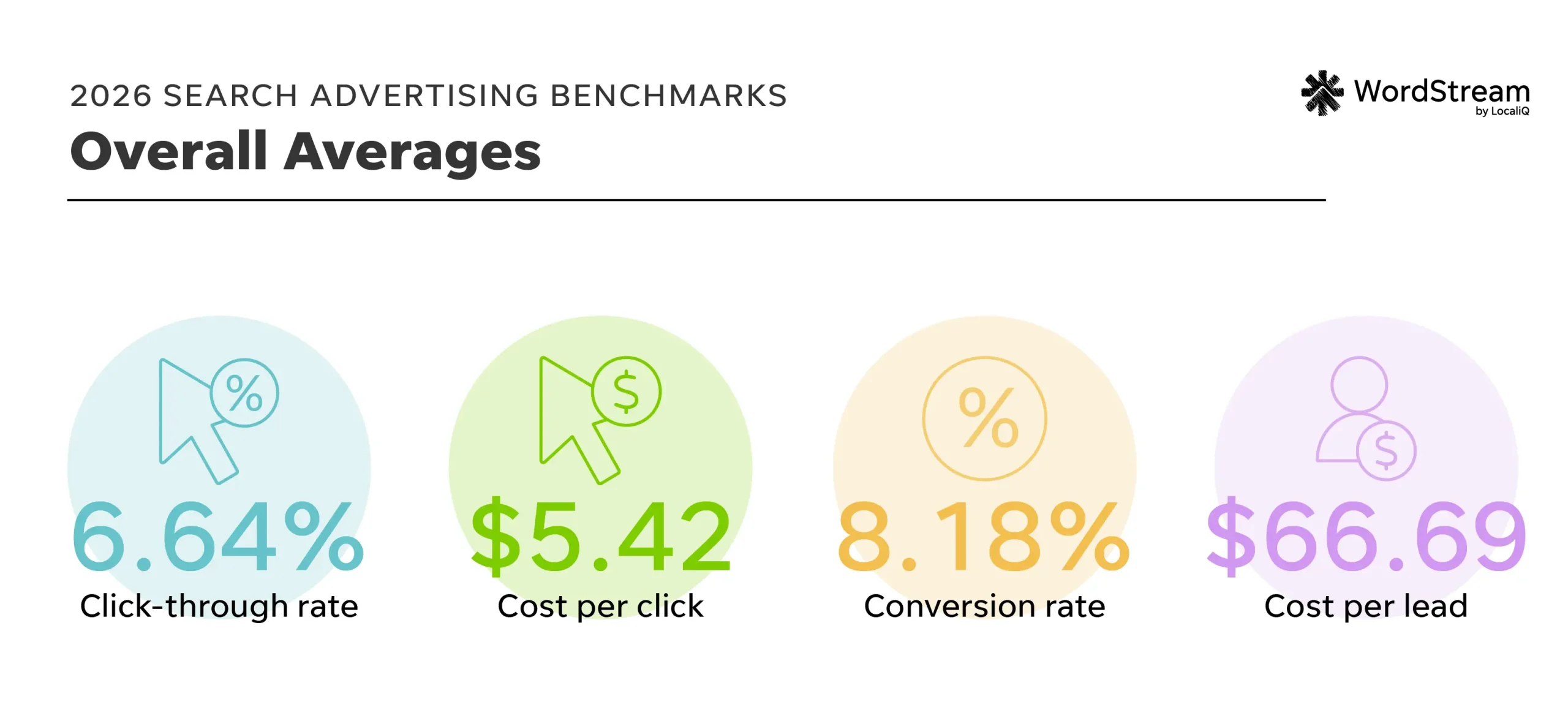
Start with the headline numbers, because they anchor everything else. The 2026 Google Ads benchmarks from WordStream and LocaliQ cover 13,474 US search campaigns that ran from April 2025 to March 2026. The median click-through rate is 6.64%, the median cost per click is $5.42, the median conversion rate is 8.18%, and the median cost per lead is $66.69.
Read those figures with three caveats, because each one changes how you use them. First, they are medians, not averages. A median keeps a few very large or very wasteful accounts from dragging the number up, which is why it is the honest headline. Second, the study mixes Google and Microsoft Ads campaigns, weighted mostly toward Google.
Treat it as a paid-search benchmark, not a pure Google price list. Third, it is US data. If you advertise in Pakistan, the UK or elsewhere, your auction will differ — but the pattern of which industries pay more holds in most markets.
One trend in the study is genuinely good news. Clicks cost about 3% more than in 2025, up from $5.26 to $5.42. Yet conversion rates rose in 87% of industries, from 7.52% to 8.18%. So the median cost per lead fell from $70.11 to $66.69. That is the first fall in five years.
Clicks got slightly dearer, and they turned into leads more often. That combination is what a healthy channel looks like.
What does a click cost in your industry? The median hides a wide spread, and the spread is the useful part. A single personal-injury case can be worth five figures, so law firms bid each other up. Nobody fights that hard over a lunch order.
The table below shows the industries at both ends, plus a few in the middle, with all three numbers that matter.
| Industry | Cost per click | Conversion rate | Cost per lead |
|---|---|---|---|
| Attorneys and legal services | $9.87 | 5.55% | $131.63 |
| Home and home improvement | $8.33 | 8.05% | $90.92 |
| Dentists and dental services | $8.00 | 10.67% | $72.97 |
| Business services | $5.87 | 4.85% | $93.69 |
| All industries (median) | $5.42 | 8.18% | $66.69 |
| Physicians and surgeons | $4.76 | 12.43% | $40.04 |
| Real estate | $3.22 | 3.70% | $102.51 |
| Travel | $2.14 | 5.83% | $44.70 |
| Restaurants and food | $2.05 | 8.05% | $30.57 |
| Arts and entertainment | $1.63 | 5.91% | $26.84 |
Two things stand out. Home improvement pays the second-highest click price, yet its leads cost less than a law firm's, because more of its clicks convert. Real estate is the warning in the other direction: a modest $3.22 click becomes a $102.51 lead, because only 3.70% of clicks turn into enquiries.
If you only compare click prices, real estate looks cheap. It is not.
The full 23-industry table behind these figures is published in the benchmark coverage summarising the WordStream study. Use your own industry's row as a sanity check, not a target. If your click price is far above your industry's median, something in your account needs fixing. If it is far below, check that you are not buying cheap, irrelevant traffic.
The chart above is the original research graphic from WordStream by LocaliQ's Google Ads Benchmarks 2026 — the study behind the numbers in this section, drawn from 13,474 US search campaigns run between April 2025 and March 2026.
Why is the lead price the number to plan around? Clicks do not pay your bills. Leads do. Cost per lead is simply cost per click divided by conversion rate, and that division explains most budgeting mistakes. A $9.87 legal click that converts at 5.55% costs $131.63 per lead.
A $4.35 automotive-repair click that converts at 15.51% costs $29.96 per lead. The cheaper click is not the cheaper lead, and the expensive click is not automatically a bad buy.
That is why this guide plans budgets from cost per lead, not cost per click. Before you read another benchmark, answer one question: what is a lead worth to you? Take your average sale value, multiply by your gross margin, then multiply by the share of leads that become customers. That is your break-even cost per lead.
Any campaign that beats it makes money. Any campaign above it loses money, however cheap its clicks look. Our guide to break-even ROAS walks through the same logic from the revenue side, and it is worth reading before you set a budget.
There is a second reason to plan from leads. It stops you celebrating the wrong metric. A campaign can double its clicks, halve its click price, and still lose money if the new traffic never converts. Leads keep the conversation honest. They are also the number your finance team will ask about, so plan in their language from the start.
How is your click price actually decided? Every search runs an auction, and you never simply pay your bid. You set the most you are willing to pay for a click, or you let Google bid toward a target for you.
Google then ranks the eligible ads by bid, ad quality and expected impact, and you pay only what is needed to beat the advertiser below you. Your maximum bid is a ceiling, not a price. In practice, you often pay less than it — sometimes much less.
Quality is the lever that makes this fairer than a pure auction. Google rates each keyword on expected click-through rate, ad relevance and landing-page experience, on a 1-to-10 Quality Score.
Google describes that score as a diagnostic tool rather than a direct auction input, but the underlying quality of your ad and landing page does feed Ad Rank, which sets both your position and your price. A relevant ad with a fast, honest landing page can outrank a bigger budget.
A vague ad pointing at a homepage cannot, whatever you bid.
That has a practical consequence for new advertisers. Do not open with a bidding war. Open with relevance: tight keyword groups, one clear offer per ad group, and a landing page that answers the search in its first screen.
The cheapest clicks in any industry usually belong to the advertiser whose page matches the query best, not the one who bid highest. If your clicks cost far more than your industry's median, relevance is the first place to look, not budget.
How does a Google Ads budget actually work? Here is the part that surprises most first-time advertisers. The number you type into Google Ads is an average daily budget, and the word that matters is average.
Google Ads Help on spending limits states the two ceilings plainly: on most campaigns you will never be charged more than twice your average daily budget on any one day, or more than 30.4 times it in a month. The 30.4 is simply the average number of days in a month.
So a $50 average daily budget means up to $100 on a busy day, but no more than $1,520 in the month. Google spends more on high-traffic days and less on quiet ones, pacing toward the monthly limit. If it ever serves more than the limits allow, it says you are not billed for the excess.
The practical point is this: your daily budget is really a monthly budget, written in daily units. Set it from what you can spend in a month, not from what feels comfortable on a single day.
That also explains the most common small-budget complaint. A $10 daily budget is $304 a month. At the all-industry median lead price of $66.69, that buys about four or five leads a month. That is not enough data to judge anything. A budget too small to produce a readable result is not a saving.
It is a test that cannot answer its own question, however long you run it.
How much budget do you actually need? Work backwards from the leads you want, not forwards from a figure that feels comfortable. The formula is simple: leads wanted, multiplied by your industry's cost per lead. The table below runs that sum for three monthly budgets at the 2026 median lead prices.
These are our arithmetic on the benchmark medians, rounded — a starting estimate, not a forecast for your account.
| Monthly budget | All industries ($66.69) | Legal ($131.63) | Home improvement ($90.92) | Restaurants ($30.57) |
|---|---|---|---|---|
| $1,000 | 15 leads | 8 leads | 11 leads | 33 leads |
| $2,500 | 37 leads | 19 leads | 27 leads | 82 leads |
| $5,000 | 75 leads | 38 leads | 55 leads | 164 leads |
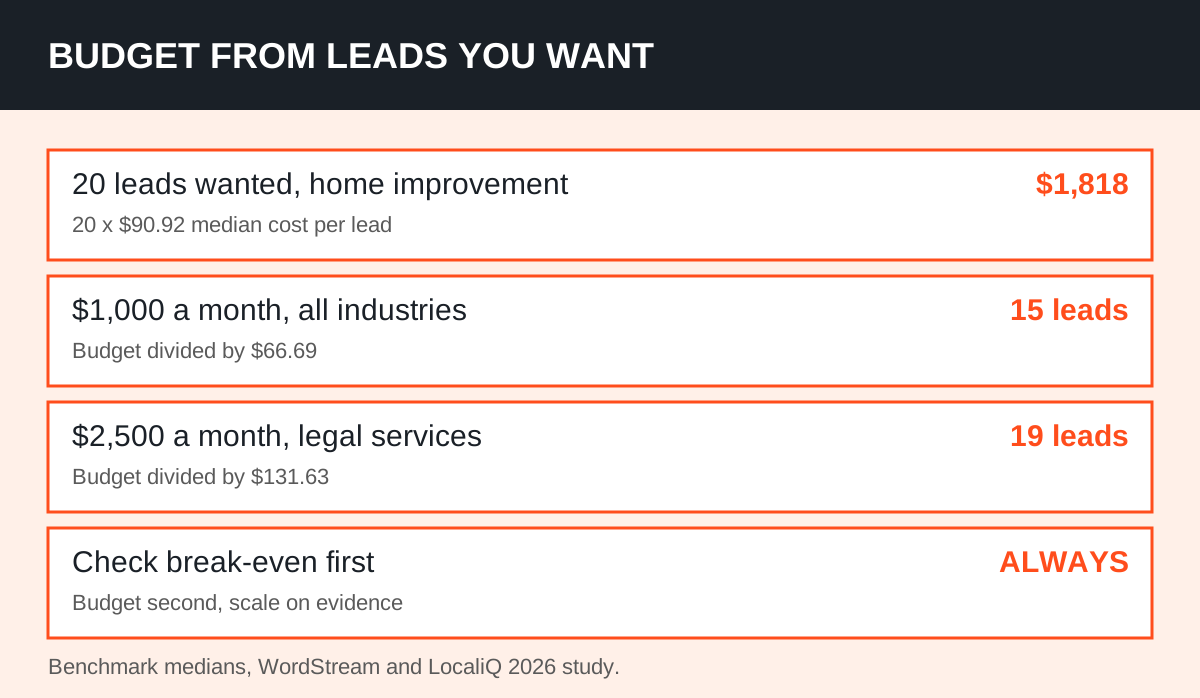
Now run the same sum with your own numbers. If you want 20 leads a month and your industry's median lead costs $90.92, you need about $1,818 of ad spend a month. If you can only afford $1,000, you should expect about 11 leads, and plan your sales follow-up around that reality. Either answer is fine.
What fails is expecting 20 leads from an $1,000 budget in a $131.63 industry, then blaming the channel when it delivers eight.
Before you commit, check the number against your break-even figure from section 03. Our break-even ROAS calculator does the revenue side of the same check: enter your average order value and margin, and it tells you the return your ads must beat.
If the budget the benchmarks imply cannot clear your break-even number, fix the offer, the landing page or the targeting first. More budget on a losing equation only loses money faster.
How do you stop paying for clicks that never convert? Most wasted Google Ads spend is not a bidding problem. It is a relevance problem, and it has four usual causes. First, search terms that should never have triggered your ad — fix them with negative keywords, reviewed weekly in the first month.
Second, a landing page that does not match the ad's promise — fix the page, not the bid. Third, no conversion tracking, or tracking that counts the wrong action — if Google cannot see what a good lead looks like, automated bidding optimises for noise.
Fourth, a campaign structure so broad that one ad group serves ten different intents, and serves none of them well.
Run a small, honest test before you scale. One campaign, one offer, one clear conversion action, and a budget large enough to buy at least 20 to 30 leads at your industry's median price. That is the minimum sample that tells you anything real.
Watch cost per lead, not cost per click, and judge the test at 30 days, not on day three. If the leads beat your break-even number, scale the winning keyword groups and landing pages.
If they do not, change one thing at a time — the page, then the keywords, then the offer — until you know which lever moved the number.
And if the account already feels messy, audit before you add budget. Our guide to running a brand audit on your own business covers the same discipline from the brand side: check what a stranger actually sees, score it honestly, and fix the worst gaps first. The same rule applies here.
A clean account on a modest budget beats a messy account on a large one, every time. If you want the paid side run for you, our paid social and PPC team plans and manages search campaigns on exactly this method: break-even first, budget second, scale only on evidence.
Frequently asked questions
How much does Google Ads cost per month for a small business?
There is no official minimum, and typical spend varies widely. At the 2026 median lead price of $66.69, a $1,000 monthly budget buys roughly 15 leads and a $2,500 budget roughly 37 — before any management fee. Most local businesses should plan on at least $1,000 to $2,500 a month of ad spend to get a readable result, and more in expensive industries like legal or home improvement.
What is a good cost per click on Google Ads?
There is no universal good number — it depends on your industry. The 2026 median is $5.42, but legal clicks cost $9.87 and arts and entertainment clicks cost $1.63. Judge your click price against your own industry's median, and judge the campaign itself on cost per lead against your break-even number, not on clicks alone.
Why can Google Ads spend more than my daily budget?
Because the budget you set is an average daily budget, not a daily ceiling. Google Ads Help states you can be charged up to twice your average daily budget on a busy day, but never more than 30.4 times it in a month. A $50 daily budget therefore caps at $100 in a day and $1,520 in the month.
Is Google Ads worth it if clicks keep getting more expensive?
It depends on what a lead is worth to you, not on the click price alone. In 2026 clicks rose about 3% on 2025, yet conversion rates rose in 87% of industries, so the median lead actually got cheaper — $66.69, down from $70.11. If your cost per lead beats your break-even number, the channel pays. If it does not, fix relevance and landing pages before adding budget.