
The guide
Every brand drifts. A logo gets stretched in a Canva template. A bio written in 2023 still promises a service you stopped selling. The website headline speaks to one customer and the TikTok speaks to another, and nobody notices because each piece was approved on its own, on a different day, by a different person. Customers notice, though. They meet your brand in fragments — a search result, a profile, a post, a checkout page — and they assemble a picture from whatever they find. If the fragments disagree, the picture is confusion, and confused customers do not buy; they leave and buy from the brand whose story held together. A brand audit is the cure for drift, and it is far less grand than it sounds. It is not a rebrand, not a strategy deck, and not a month of workshops. It is a structured look at what your brand actually says, shows and does right now, scored honestly, so you can fix the worst gaps first instead of redesigning everything at once. Done properly it takes about two hours for a small business, it costs nothing but attention, and it answers the question every founder eventually asks: is the problem my product, my marketing, or the way the two fail to match? This guide runs the whole audit, step by step, with the scorecard we use, a worked example, and the order to fix things in.
Two hours, six areas, one honest scorecard. Gather the evidence like a stranger, score what you find, and fix the worst gap first — before you spend another dollar on ads.
Key takeaways
What a brand audit actually is, and what it is not
A brand audit answers one question: does the brand customers experience match the brand you think you have? It does that by collecting evidence — your website, social profiles, content, reviews, emails, packaging if you have any — and judging each piece against the same standard.
The output is not a mood board and not a logo critique. It is a short list of gaps, ranked, with a fix for each one.
What it is not matters just as much. It is not a rebrand: you do not need a new logo because your Instagram bio is out of date. It is not a competitor obsession exercise: you look at competitors to calibrate, not to copy.
And it is not a verdict on taste — plain and consistent beats beautiful and contradictory. The brands that fail audits are rarely the ugly ones; they are the ones that say "premium and personal" on the website, run discount-led ads, and reply to comments in a different voice entirely.
Set the scope before you start, or the audit will swallow the week.
For a small business, the scope is everything a new customer can find in their first hour with you: your website homepage and one key page, every social profile you still link to anywhere, your Google Business Profile if you have one, your last twenty posts, your reviews from the last six months, and one email a customer receives.
That small territory is deliberate: an audit that covers everything a stranger sees is worth more than a deep dive into one channel that misses the contradiction sitting in the next one.
The six areas, and how to score them
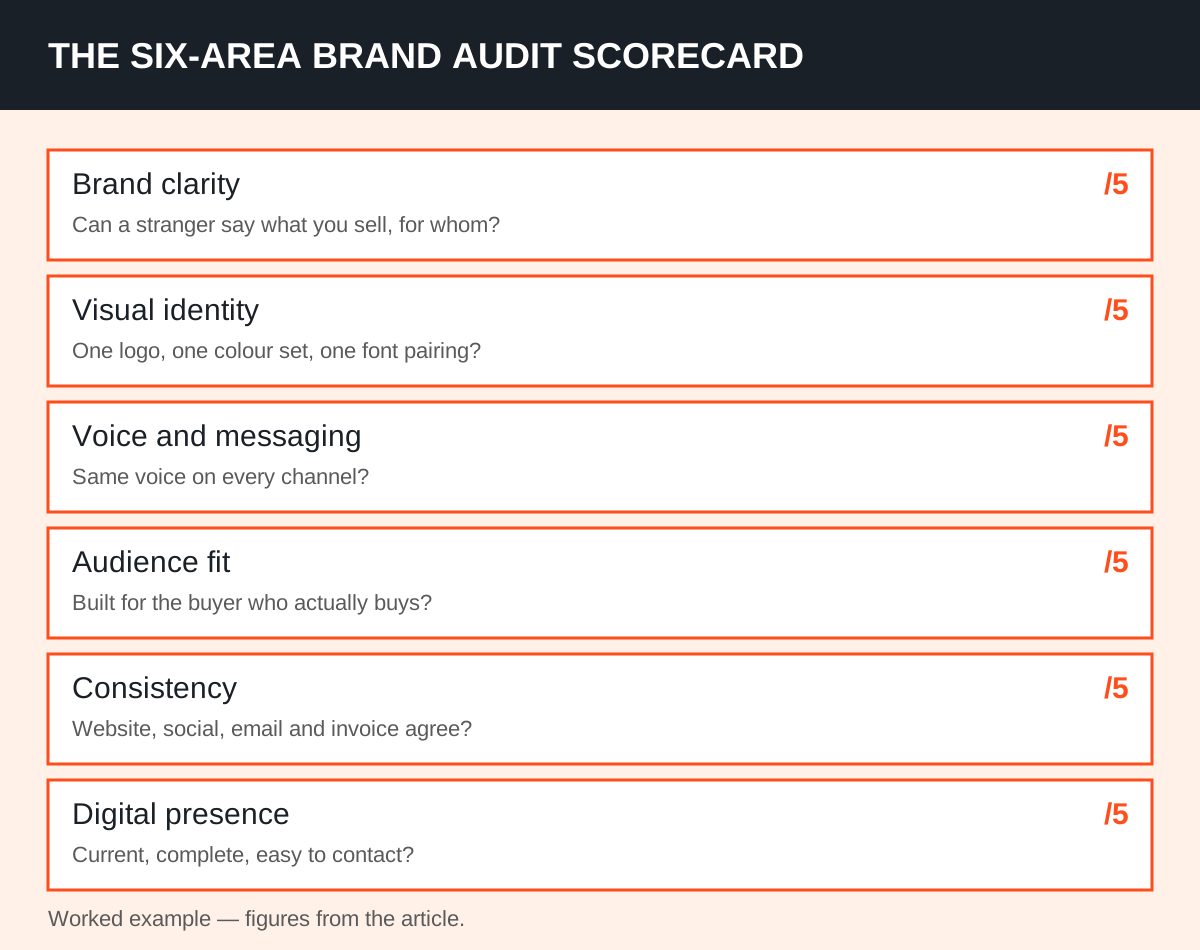
Six areas cover a small brand completely, and six is few enough that you will actually finish. Score each area from 1 to 5: 1 means broken or missing, 2 means present but weak, 3 means solid with visible gaps, 4 means strong with small fixes, 5 means a stranger would describe it exactly as you would.
Write one sentence of evidence for every score, because a number without a reason cannot be fixed.
The six areas are these. Brand clarity: can a stranger say, in one sentence, what you sell, for whom, and why you rather than anyone else? Visual identity: do your logo, colours, type and imagery look like one brand, or several brands sharing a password?
Voice and messaging: does everything sound like it was written by the same person, in a voice your customer would recognise? Audience fit: is it built for the customer who actually buys, rather than the one you wish bought? Consistency across touchpoints: do the website, social profile, email and invoice agree with each other?
Digital presence: where you show up, do you show up well — current, complete, maintained, and easy to contact?
Add the six scores for a total out of 30.
Read it as a triage band, not a league table: 24 to 30 means the brand is working and you fix the lowest area only; 17 to 23 means good bones with real gaps, and you fix the lowest two areas before anything new; 10 to 16 means the foundation needs work before more marketing spend, because ads will only amplify the confusion; below 10 means stop and rebuild the core message first.
These bands are our working method for this guide, not an industry standard — no such standard exists. What matters is that your own scores are comparable next time, so use the same six areas and the same scale every time.
Gather the evidence like a stranger
Do not audit from memory. Memory is the reason the drift happened: you remember what you meant, not what is there. Open your phone, the device your customers actually use, and meet your brand as a stranger would. Search your business name and click the first result.
Read the homepage headline out loud: would a stranger know what you sell from that sentence alone? Then open every profile you link to anywhere and screenshot anything that contradicts the homepage. Check your Google Business Profile for wrong hours, old photos and unanswered reviews, because for a local searcher that listing is your homepage.
Read your last twenty posts as a single story: do they sound like one brand, or like whoever had the password that week?
Then gather the evidence only an owner can see. Pull the last ten customer messages, comments and reviews, and write down the exact words customers use for what you do — that language is your real positioning, whether or not it matches your tagline.
Open the last email a customer receives after buying, and check whether it sounds like your brand at all. Look at your last month of ads, if any, and ask whether the promise in the ad survives contact with the landing page. That folder of screenshots and notes is the audit.
Everything after this is just judging it honestly, which is the part most people skip by going straight to redesigning the logo.
Score honestly, with a worked example
Scoring is where audits die, because scoring your own brand honestly feels like grading your own child. Two rules keep it honest. First, score the evidence, not the intention: the bio you meant to update scores as the bio that is actually there.
Second, if you cannot decide between two scores, take the lower one — an audit that flatters you is a wasted afternoon, and the lower score only costs you a fix you probably needed anyway.
Here is the method on a fictional example, so the arithmetic is visible. A small skincare brand, selling online, scores like this: brand clarity 4 — the homepage says exactly who the products are for, but the tagline promises something the range does not deliver.
Visual identity 3 — the packaging is beautiful and the social grid is not, because Canva templates drifted over a year. Voice and messaging 2 — the website is warm and expert, the ads are discount-led, and the comment replies are terse.
Audience fit 3 — the content speaks to the right buyer but the checkout language assumes knowledge a first-time buyer does not have. Consistency across touchpoints 2 — the email signature carries an old logo and the invoice is unbranded. Digital presence 3 — the profiles are current but reviews go unanswered and the Google listing has two-year-old photos.
Total: 17 out of 30 — good bones, real gaps, fix the lowest two areas first. Notice what the total does not say: it does not say "rebrand." It says fix the voice and the touchpoints.
That is the typical audit result, and it is why audits save money: they replace a five-figure redesign with a fortnight of small, specific fixes.
Read the pattern before you fix anything
Individual low scores are symptoms; the pattern across them is the diagnosis. Low clarity plus low audience fit usually means the business has never written down who it serves, and every channel has invented its own answer — the fix is one positioning sentence, agreed once, then rolled out everywhere, not six separate rewrites.
Low voice plus low consistency usually means nobody owns the brand day to day, so each platform drifts on its own — the fix is an owner and a one-page voice guide, not a new tone of voice.
Low digital presence alone, with everything else strong, usually means the brand is fine and its shopfront is neglected — the fix is a maintenance routine, not a strategy.
Check the pattern against what customers actually said, because the audit can lie if it only listens to you. If customers consistently describe you in words your brand never uses, your positioning lives in their heads, not in your copy, and the fix is to adopt their language rather than educate them out of it.
If reviews praise one thing and complain about one thing, those are your real strengths and your real gap, whatever your scores said.
And check the pattern against how an AI assistant would describe you, which is the subject of our agentic-commerce readiness audit — https://learnwithmaneeza.com/agentic-commerce-readiness-audit/ — because the description an AI gives a buyer is now part of the brand customers meet, whether you wrote it or not.
When the pattern, the customers and the AI description all point at the same gap, you have found the fix that matters. When they disagree, trust the customers first.
From findings to fixes: the order that actually works

A findings list without an order becomes a guilt list, and guilt lists get ignored. Fix in this order, and do not start the next tier until the one above it is done.
First, broken trust signals: wrong prices, dead links, old contact details, unanswered complaints — anything that makes a buyer doubt whether you are still in business. A single dead checkout link undoes a month of good content, and it takes ten minutes to fix.
Second, confused messaging: the homepage headline, the bios, the one sentence that says what you sell and for whom — rewrite it once, then change it everywhere the same day, because a new message on one channel and the old message on five others is worse than the old message everywhere.
Third, inconsistent visuals: one logo file, one colour set, one font pairing, used everywhere, with old files deleted rather than left to be reused by accident. Fourth, weak proof: unanswered reviews, missing testimonials, claims without evidence — the material that turns a stranger's interest into trust.
Fifth, quiet channels: the profile you never post on, the email list you never mail. Notice what is last, not first: more content. Brands that audit and then immediately post more are amplifying the same confusion louder, and the audit's whole point was to stop that.
Give every fix an owner and a date, even if the owner is you and the date is Friday, because a fix without a date is a wish. One fix per area, in this order, is a complete audit outcome. Ten fixes with no order is a document nobody opens again.
Do it yourself, then get a second pair of eyes
Run this audit yourself first, on the schedule that keeps drift from returning: a full audit every six months, and a thirty-minute touchpoint check every quarter — homepage, bios, reviews, one email — because brands drift in quarters, not years.
Keep the scorecard and the evidence folder, and score against the same six areas each time, so the trend is visible: a brand whose consistency score rises from 2 to 4 over two audits is getting healthier, and that trend is worth more than any single total.
Then, once you have your own scores, get a second pair of eyes on the same evidence, because the hardest part of a self-audit is seeing your own blind spots.
That is exactly what our free Brand Audit does: you tell us about your brand, and our team audits it by hand — your website, your social presence and a snapshot of your competitors — and sends you a written report: https://learnwithmaneeza.com/brand-audit/ — use it to check your own scores against an outside read, or to hand the whole job to someone else when the audit keeps slipping down your own to-do list.
And when the audit points at content and social systems rather than a one-off fix — the voice guide nobody maintains, the profiles that go quiet — that is the ongoing work our content and organic team does: https://learnwithmaneeza.com/service/content-organic/ — because an audit is a photograph, and a brand is a film.
Take the photograph, fix what it shows, and then keep the camera rolling.
Frequently asked questions
What is a brand audit?
A structured check of what customers actually experience — your website, social profiles, content, reviews and customer emails — scored against the same standard so the gaps can be ranked and fixed. It is not a rebrand: most audits end in a fortnight of small, specific fixes, not a new logo. The output is a short, ordered fix list, not a strategy deck.
How long does a DIY brand audit take?
About two hours for a small business: roughly 30 minutes gathering evidence like a stranger on your phone, 45 minutes scoring the six areas honestly, and 45 minutes reading the pattern and writing the fix list. A quarterly touchpoint check — homepage, bios, reviews and one email — takes about 30 minutes and stops drift from building up again.
How often should you run a brand audit?
A full audit every six months, with a short touchpoint check every quarter. Brands drift in quarters — a new template here, an outdated bio there — so waiting a year means auditing a year's worth of drift at once. Score against the same six areas each time so the trend, not just the total, tells you whether the brand is getting healthier.
What is the difference between a DIY audit and your free Brand Audit?
The DIY audit in this guide is yours to run with the six-area scorecard; our free Brand Audit is a second pair of eyes — our team audits your brand by hand, covering your website, your social presence and a snapshot of your competitors, and sends you a written report: https://learnwithmaneeza.com/brand-audit/ — use it to check your own scores against an outside read.