
The guide
A year ago, "AI checkout" was a demo. Today it is a set of half-open doors: ChatGPT can discover your products but mostly sends the buyer to your site, Google is switching on checkout inside AI Mode for eligible US stores, Perplexity lets Pro subscribers buy without leaving the chat, and Walmart just opened its systems to ChatGPT, Gemini and Meta's Muse. None of this is science fiction — and none of it is finished either. The store owners who win the next two years won't be the ones who integrated the most agent protocols. They'll be the ones whose product data was clean, whose checkout an agent could actually complete, and whose brand the models already knew how to recommend. That is what this audit checks.
Six checks, about thirty minutes, no new software: find out where your store stands before the holiday season hands the agent-referred sale to a competitor.
Key takeaways
The honest state of AI checkout
Start with what is actually live, because the hype cycle here is loud. OpenAI announced Instant Checkout inside ChatGPT on 29 September 2025, built on the Agentic Commerce Protocol — an open standard it co-developed with Stripe — the protocol is documented in Stripe's developer documentation.
Then, in March 2026, OpenAI scaled the in-chat purchase back: ChatGPT today is discovery-first, and most purchases complete on the merchant's own site. Google went the other direction.
After announcing agentic checkout in November 2025, it emailed eligible Shopify stores on 22 September 2026 to say their products were being switched on for native checkout inside AI Mode and Gemini — on by default, with manual opt-out. Perplexity's Buy with Pro, on PayPal rails, gives US Pro subscribers one-click checkout without leaving the chat, still in beta.
And in the third week of October 2026, Walmart launched an Agent Gateway connecting ChatGPT, Gemini and Meta's Muse directly to Walmart and Sam's Club systems.
Read that landscape once and the pattern is obvious: every major surface is converging on the same deal. The assistant discovers and recommends; the purchase happens wherever the merchant's data and checkout allow it to happen.
Shopify's own numbers keep this honest — the company describes agentic GMV as still small, and its October 2026 catalog opening for any AI agent shipped without checkout webhooks. So the audit below is not about bolting on a new checkout.
It is about making sure that when an agent — or the human it advises — arrives, your store is findable, readable and buyable. The companion check is whether ChatGPT can see your business at all.
Check one: can AI find and recommend you?
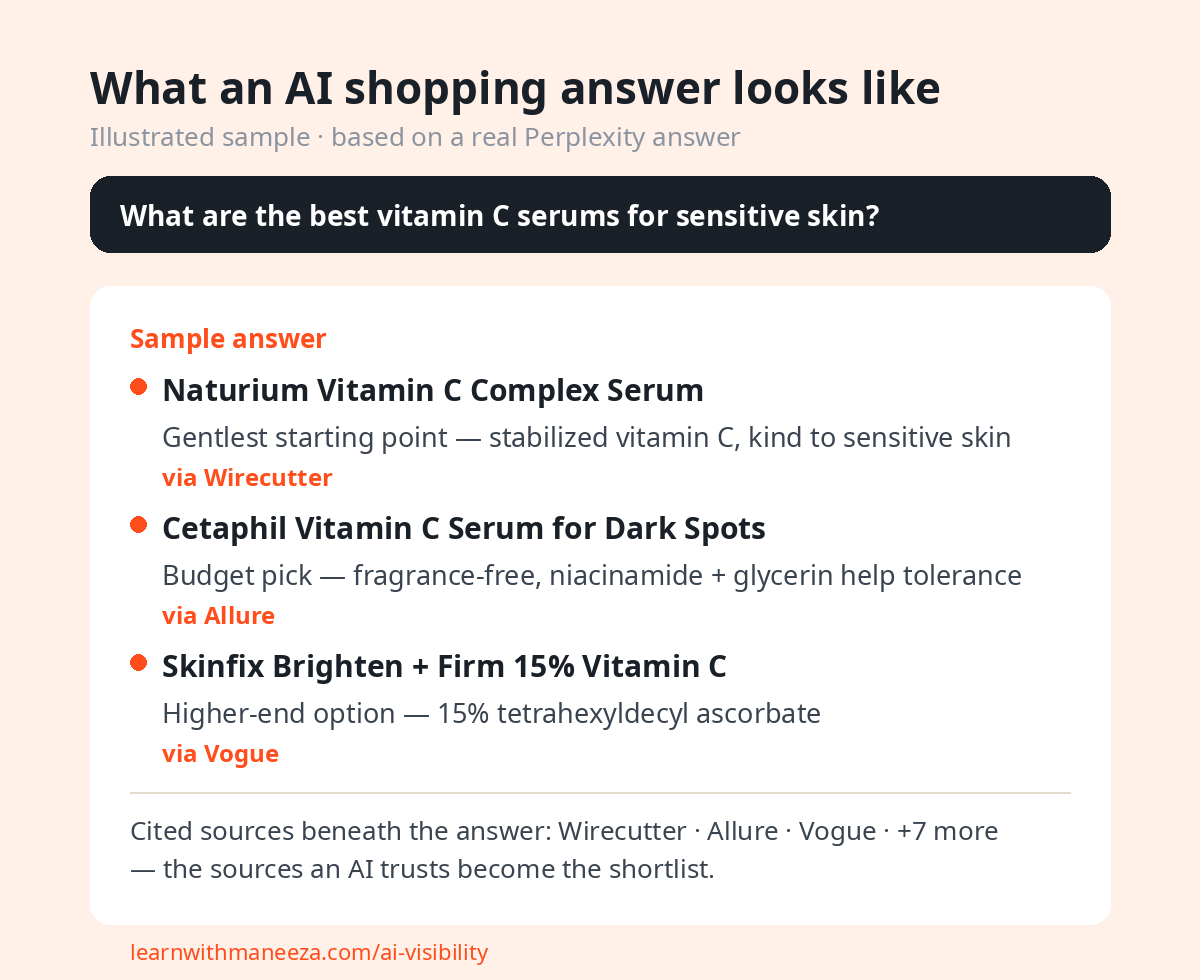
Before any protocol matters, there is a simpler question: when a buyer asks an AI "what's the best vitamin C serum for sensitive skin?", does your brand get named? Run this yourself before you read further. Ask ChatGPT, Perplexity and Gemini two or three prompts your real buyers would type — not your brand name, the problem you solve. Note three things:
- Are you mentioned at all?
- Is what the model says about you accurate?
- Does it cite your site — or someone else's?
What you are looking at is the new shelf. A sample answer names products, links sources, and the sources it trusts become the shortlist. If you appear nowhere, that is a discoverability problem, and it is the first thing to fix — because every later check in this audit is worthless if the agent never considers you. If you appear but the facts are wrong — discontinued products, old prices, a tagline from three rebrands ago — that is a data problem, and checks two and three are where it gets fixed.
We run this check by hand for every AI Visibility Snapshot: real buyer prompts across ChatGPT, Perplexity and Gemini, checking whether the brand gets named and what the models repeat about it. Doing it yourself once a quarter is free and takes twenty minutes. The discipline that matters is using buyer prompts, not brand prompts — nobody discovers you by asking for you by name.
Check two: is your product data machine-readable?
Agents don't browse your beautifully designed product pages. They read your data — and they are unforgiving about staleness. OpenAI's merchant requirements spell it out: a full product feed refreshed at least daily, with price and stock pushed in real time.
A stale feed or a price mismatch is an eligibility risk on ChatGPT, Perplexity, Google and Copilot alike. Google's side of the same rule: the legacy Content API for Shopping shut down on 18 August 2026, so any integration still on it needs to be on the Merchant API now.
Then there is the page itself. Valid schema.org Product and Offer JSON-LD — price, currency, availability, SKU and ideally GTIN — is the practitioner-consensus gate. Agents treat the GTIN as the primary matching key across the web: it is how a model knows the serum on your site is the same serum reviewed elsewhere.
Add MerchantReturnPolicy and shipping schema while you are in there; the return-policy markup practitioners recommend is exactly the data agents need to answer "can I return this?" without guessing.
None of this is new technology. It is the unglamorous feed-and-markup work most stores half-finished years ago. The difference now is that the consumer of that data isn't just Google's crawler — it's a shopping agent deciding whether your product makes the shortlist.
Check three: can an agent actually complete your checkout?
Here is where audits most often fail. DigiMirror's October 2026 audit of agent-ready Shopify stores found plenty that break before the buy button — and the breakage is usually self-inflicted: forced account creation, CAPTCHA walls on checkout, bot rules that treat every non-human visitor as hostile.
The fix is not to remove all defences. It is to stop blocking verified agents wholesale and start distinguishing them. Visa's Trusted Agent Protocol, introduced with Cloudflare in October 2025, exists precisely for this: cryptographic signatures that let a merchant verify a legitimate shopping agent instead of guessing.
Cloudflare has run a public Agent Readiness score since April 2026. The grounded rule: guest checkout, no CAPTCHA on the payment step, and bot management that admits signed agents rather than a blanket block.
Shopify is moving the goalposts helpfully here.
Its Storefront MCP has been live since March 2026, and on 28 September 2026 it extended WebMCP to checkout itself — get_checkout, update_checkout and complete_checkout — with guardrails that should reassure you: the agent must show the buyer the order total and get consent before completing, no new card details are accepted, and 3D Secure hands back to the shopper.
If you are on Shopify, check that these agent surfaces are actually reachable on your store rather than smothered by an overzealous security app.
Check four: policies, crawlers and payments
Three smaller gates, each cheap to fix, each capable of quietly disqualifying you:
- Policies: Shopify's agentic-storefront eligibility requires completed shipping and returns policies — not drafts, not "coming soon" pages. Publish them as real pages and mark them up so machines can parse them.
- Crawlers: a blanket Disallow in robots.txt blocks every bot that respects it, including OAI-SearchBot, PerplexityBot, ChatGPT-User and Google-Extended. Check that you are not accidentally shutting AI out while trying to block scrapers — the two are different problems now.
- Reviews: Bazaarvoice started feeding authentic ratings directly into shopping agents' product memory in October 2026 — collected reviews are becoming agent-readable trust data, not just page decoration.
Third, payments. The honest answer on agent payments in October 2026 is that almost all of it sits with your acquirer or processor: Stripe, Adyen and Checkout.com have announced or piloted agent-payment support, Visa's Intelligent Commerce Connect is in pilot, Mastercard's Agent Pay is live only in Malaysia and Singapore. There is no "turn on agent payments" button in your store dashboard. Your job is narrow: ask your processor what they support, and make sure a verified agent can reach a checkout it is allowed to call.
The shortcut: our AI Visibility Snapshot
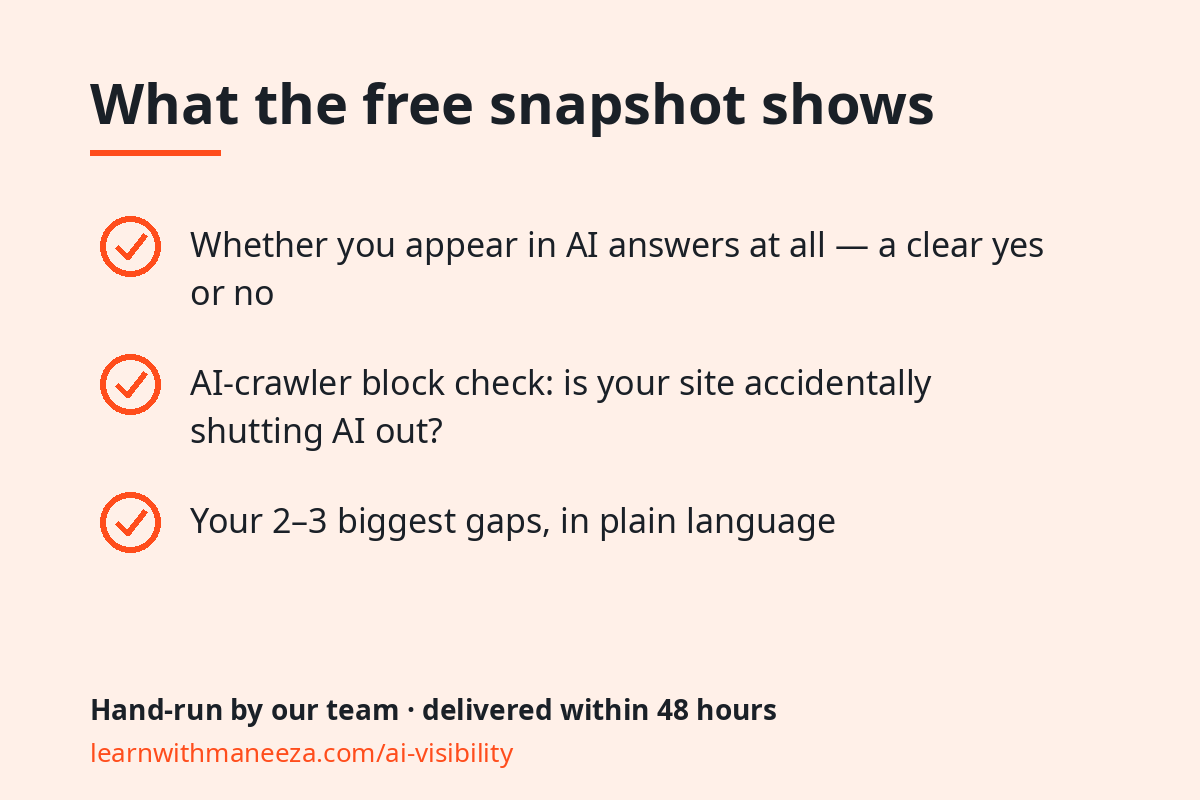
Checks one through five are the method. If you want the first check done for you, that is what our AI Visibility Snapshot exists to do. The free snapshot is deliberately narrow: it proves whether the problem is real.
We ask ChatGPT, Perplexity and Gemini the questions your buyers actually ask, check whether your brand gets named, run the AI-crawler block check on your site, and hand you your two or three biggest gaps in plain language — within 48 hours, run by hand, not by a script.
The full report goes further — fifteen to twenty buyer prompts across all three engines, run three times each because AI answers vary, your mention rate against up to three competitors, what the models actually say about you including anything they get wrong, the complete technical check, and a prioritised fix plan.
But start with the free snapshot: https://learnwithmaneeza.com/ai-visibility/ — if the answer is "you're invisible", you now know exactly which of the checks above to work through first.
Your 30-minute audit order
Work the checks in this order and you will have a real answer by the end of the hour:
- Prompt-test your brand on all three engines with buyer prompts — ten minutes, and it tells you whether the rest is urgent.
- Check robots.txt for a blanket block on AI crawlers — two minutes.
- Verify your product feed's refresh cadence, and fix the Merchant API migration if it is still pending — the most common eligibility failure.
- Validate your Product/Offer JSON-LD and add GTINs where they exist.
- Publish complete shipping and returns pages, and mark them up.
- Walk your own checkout as a guest and remove anything a machine can't pass.
- Email your payment processor one question: what agent-payment support do you offer today?
Two things worth reading next: our workflow-first guide to choosing AI tools without drowning in them — https://learnwithmaneeza.com/ai-tools-ecommerce-content/ — and if the audit turns up storefront work (structured data, checkout friction, feed plumbing), that is the unglamorous core of our web development practice: https://learnwithmaneeza.com/service/web-development/ . The agent era doesn't change what a good store is. It just makes the sloppy parts visible to something that never gets tired of checking.
Frequently asked questions
Is AI checkout actually live, or is this still hype?
Both. Discovery inside AI assistants is live and growing — ChatGPT, Perplexity, Gemini and Meta's Muse all recommend products today. But in-assistant purchasing is limited: ChatGPT scaled Instant Checkout back to discovery-first in March 2026, Google's native checkout is US-only for eligible merchants, and Perplexity's one-click buying is a US Pro-subscriber beta. Most AI shopping journeys still end with a redirect to your own checkout, which is exactly why the audit focuses on your data, not a new integration.
Do I need an llms.txt file for AI shopping agents?
No major AI vendor has confirmed their crawlers or agents read llms.txt, so treat it as insurance, not a requirement. The verified gates are a fresh product feed, valid schema.org Product/Offer markup, completed policies and not blocking AI crawlers in robots.txt. Do those four before spending time on anything else.
I'm on Shopify — am I already agent-ready?
Partly. Shopify switched Agentic Storefronts on by default for eligible stores in March 2026 and opened its catalog to any AI agent in October 2026, so discovery surfaces may already include you. But your feed freshness, JSON-LD markup, completed shipping/returns policies and a checkout that verified agents can complete are still your responsibility — and you can opt out of direct checkout while keeping discovery if you'd rather buyers land on your site.
What does the free AI Visibility Snapshot actually check?
Three things: whether your brand appears in AI answers at all, an AI-crawler block check on your website, and your two or three biggest gaps in plain language. Our team runs it by hand across ChatGPT, Perplexity and Gemini, and it lands within 48 hours. It proves whether the visibility problem is real before you spend anything fixing it: https://learnwithmaneeza.com/ai-visibility/