The guide
There is a new shelf in retail, and it doesn't have your packaging on it. When a buyer asks an AI assistant "what's the best CRM for a five-person agency?" or "where should I get my wedding cake in Lahore?", the answer that comes back is a shortlist — and shortlists decide where money goes. McKinsey's April 2026 consumer research found 63% of European consumers now use AI tools to compare brands, models, prices and reviews, and 46% use them for product discovery. Adobe's July 2026 study of 5,000 US consumers found 42% have used AI assistants for online shopping — and 89% of those shoppers click the links and sources the AI provides. The question is no longer whether your buyers ask AI about what you sell. It is whether the AI knows you exist.
Five buyer prompts, three engines, twenty minutes: a practical visibility test you can run today, plus what to do with each possible result.
Key takeaways
Why "being in the model" is a discovery channel now
For most of the web's history, discovery meant one thing: ranking on a search results page. AI assistants changed the shape of the answer. Instead of ten blue links, the buyer gets a synthesized recommendation — often with cited sources beneath it.
Perplexity retrieves real-time information from the web and cites its sources on every answer; ChatGPT runs what analysts call shopping query fan-outs, retrieving products and synthesizing a reasoned recommendation; Gemini answers increasingly carry a handful of citations too.
The traffic numbers say this is already a channel, not a curiosity.
Adobe's Digital Insights team reported AI-driven traffic to US retail sites up 138% year on year in May 2026 — and those AI-referred shoppers converted 54% higher than average, generating 53% more revenue per visit. (Source: Adobe Digital Insights.) Yelp's October 2026 survey of 2,202 US adults found 65% have used AI search, and 72% want AI platforms to show where their information comes from. (Source: Yelp's October 2026 survey.) Buyers are not just asking — they are clicking through, and they care about the sources.
So "does ChatGPT know my business?" is not a vanity question. It is the 2026 version of "do I rank on page one?" — with one difference that works in your favour: unlike Google's rankings, this test takes twenty minutes and a free account.
If you want the full commerce-readiness picture after this test, our agentic-commerce audit covers the six checks that decide whether an AI can actually sell for you — https://learnwithmaneeza.com/agentic-commerce-readiness-audit/
Step one: build your buyer-prompt set
The single most common mistake in DIY visibility tests is typing your own brand name into the prompt. That tells you nothing — nobody discovers a business by asking for it by name. The 2026 playbooks all converge on the same method: a fixed library of buyer prompts, with your brand name nowhere in them.
Write 5 to 10 prompts the way your real buyers would type them:
- "best [your product category] for [specific use case]"
- "[your product category] under [price point] worth buying in 2026"
- "who makes the best [product] for [audience]?"
- "alternatives to [market leader] that are cheaper"
- "[service] near me with good reviews" (if you serve a local market)
- "is [category] worth it, or should I just [cheaper alternative]?"
Two rules for the set. First, mix formats: a couple of direct recommendation asks, a couple of comparison asks, one or two "worth it?" questions — because AI answers behave differently across formats, and your visibility can too. Second, freeze the set: write the prompts down and reuse the exact same ones every time you test. The whole point is comparability across runs and across engines.
Step two: run it clean, twice
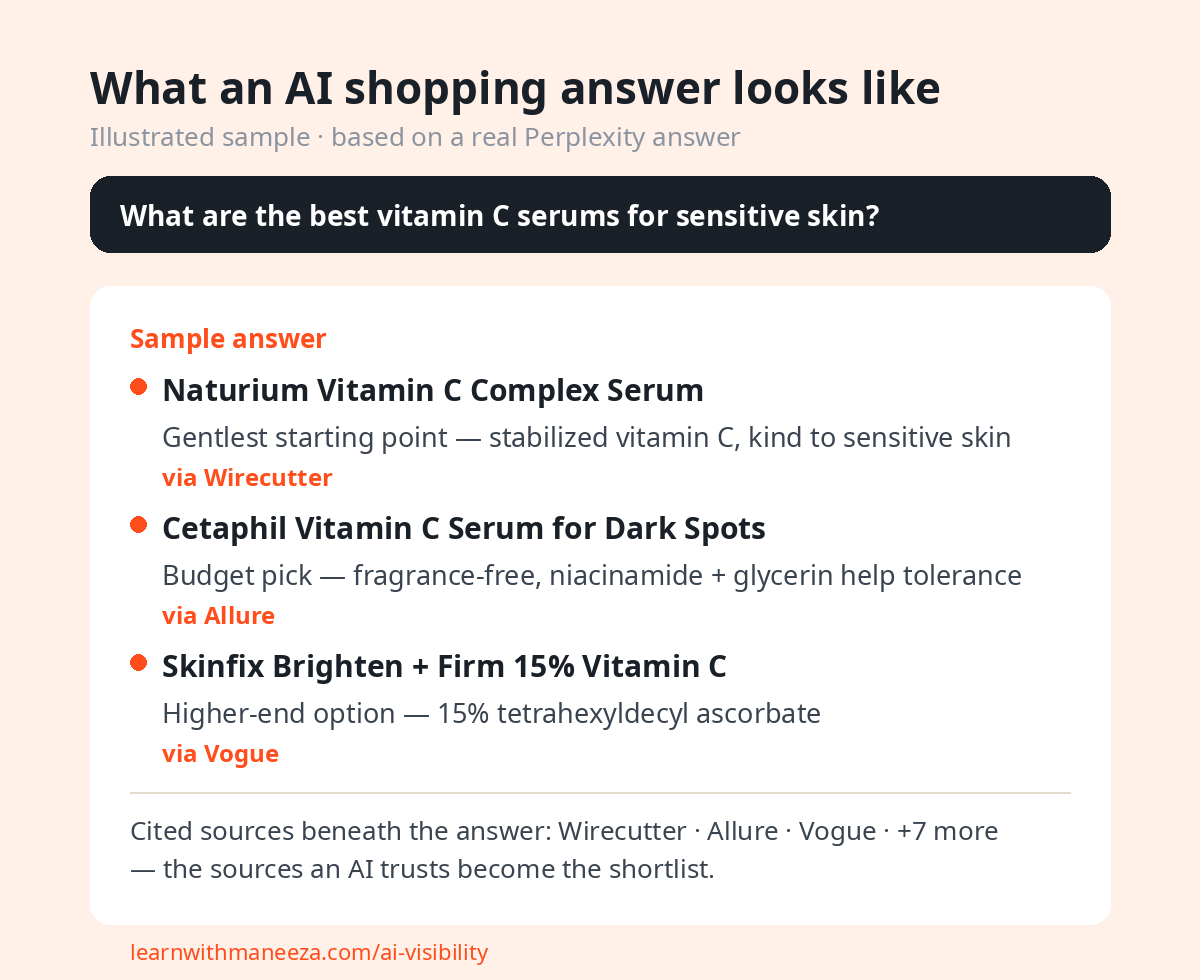
Now run every prompt on all three engines — ChatGPT, Perplexity and Gemini — in fresh sessions (a new chat each time, or a private window), and run each prompt at least twice. The repetition is not paranoia: practitioner guides from across 2026 are unanimous that AI answers vary between runs, so you score trends, not single results. Two runs per prompt per engine is the minimum that keeps this honest; three is better if you have the patience.
For each answer, record three things:
- Mentioned? — does your brand appear at all, named or clearly described?
- Accurate? — is what it says about you true: current products, current prices, correct positioning?
- Cited? — does it link your site as a source, or does the information come from someone else's page?
Score it simply: one point per yes, per prompt per engine, averaged across your runs. What you end up with is three numbers per engine — a mention rate, an accuracy rate and a citation rate. The mention rate is the headline number: it is the share of buyer questions where you exist at all. The accuracy and citation rates tell you whether existing is helping or hurting.
Step three: read the answers like a scorecard
The numbers are only half the story. Read the actual answers, because the pattern in them tells you the cause.
If you are invisible everywhere, the problem is usually upstream of content: the engines cannot read you, or there is nothing current to read.
If you are mentioned but described wrongly — discontinued products, prices from two years ago, a tagline from a rebrand ago — the problem is stale data: the models learned you from old pages and nobody has fed them anything newer.
If you are mentioned accurately but the citation goes to a review site, a directory or a competitor's comparison page instead of yours, the problem is authority: the engines trust someone else's description of you more than your own.
And if one engine sees you and another doesn't, look at that engine's supply chain — Google's AI Mode reads from Merchant Center feeds and crawled store pages, Perplexity leans heavily on cited web sources, ChatGPT mixes its training data with live search.
One more thing to note while you read: where the citations point. A September 2026 analysis of local-business answers found Perplexity credited the business's own website in roughly half of its picks, while ChatGPT most often credited third-party review and list pages.
Your own pages can absolutely be the cited source — but for many businesses, especially local ones, the cited source is a review platform. That is a clue, not a verdict: it tells you where your reputation currently lives.
What each result means, and which fix it points to
Four outcomes, four diagnoses:
- Invisible everywhere — start with the plumbing. Check robots.txt for a blanket block on AI crawlers (more on the exact rules in the next section), confirm your site is actually indexed, and check whether you have any product presence in Google's Merchant Center. Plumbing first, because no amount of content fixes a door that is bolted shut.
- Mentioned but wrong — this is a freshness problem. Update the pages the engines are reading: your homepage positioning, product pages, pricing, and your schema.org markup. For ecommerce, OpenAI's merchant spec is explicit — full product snapshot at least daily, intraday price and stock upserts, nine required fields — because stale feeds are an eligibility risk, not just a cosmetic one.
- Mentioned and accurate, but someone else gets cited — this is an authority gap. The engines believe third parties about you more than they believe you. Close it with reviews on the platforms AI answers actually cite, and with content that answers buyer questions so directly that your page becomes the best source to quote.
- Visible and cited — congratulations, and don't get comfortable. AI answers drift as models retrain and sources reshuffle. Re-run this test quarterly; fifteen minutes, same prompt set, and you will catch drift before it costs you.
The fixes, in order of effort
Work these in order. Each one is cheap; together they cover nearly every invisibility case we see in snapshot runs:
- robots.txt, done precisely. Do NOT blanket-block AI crawlers. The one that matters for ChatGPT search answers is OAI-SearchBot — OpenAI's docs say it follows robots.txt, and blocking it removes you from search-sourced answers. GPTBot is training-only, so blocking it is a separate decision about model training, not about today's answers. One nuance from OpenAI's December 2025 docs revision: ChatGPT-User (the bot that fetches a page when a user asks) "may not" apply robots.txt rules — so robots.txt is a gate for search indexing, not a privacy tool. Be specific: allow OAI-SearchBot, decide on GPTBot deliberately, and don't pretend a Disallow line hides anything from a user-initiated fetch.
- Google's surfaces: get into Merchant Center and switch on free listings. Google's own guidance says Merchant Center feeds help products appear in AI responses as well as classic search — and AI Mode reads from free listings, not ads. If you sell in the US, Canada, UK, India, Australia or New Zealand, check the AI performance report Google made generally available in September 2026: it shows your share of voice across AI Mode and AI Overviews, which is the closest thing to a first-party visibility dashboard that exists.
- Reviews where AI looks. Yelp licensed its ratings, photos and listings to OpenAI — the deal emerged in late July 2026 — specifically so ChatGPT can answer local queries with Yelp data. For local businesses that single relationship makes Yelp non-optional. Beyond local, the platforms that show up most in AI citations by query type are G2 and Capterra for B2B software, Trustpilot for ecommerce credibility, Clutch for agencies. You don't need all of them; you need the one or two your buyers actually check.
- Content that answers buyer questions. The pages AI cites are the pages that directly answer the prompt: comparison content, "best for X" guides, pricing explainers, honest limitation sections. This is the unglamorous core of our content practice — https://learnwithmaneeza.com/service/content-organic/ — because the same problem-led content that ranks also gets quoted.
- Keep the machine-readable layer fresh: valid schema.org Product/Offer markup, current prices and availability, completed policies. It is the same hygiene our agentic-commerce audit checks, and it is what lets an engine describe you accurately instead of guessing from a 2024 blog post.
The shortcut: our AI Visibility Snapshot

Everything above is the method, and running it yourself once a quarter is free. But it is also twenty minutes of careful, slightly tedious work — and the scoring is only as good as the prompts you write.
That is what our AI Visibility Snapshot exists to do for you. The free snapshot is deliberately narrow: it proves whether the problem is real.
We ask ChatGPT, Perplexity and Gemini the questions your buyers actually ask, check whether your brand gets named, run the AI-crawler block check on your site, and hand you your two or three biggest gaps in plain language — within 48 hours, run by hand, not by a script.
The full report goes further — fifteen to twenty buyer prompts across all three engines, run three times each because AI answers vary, your mention rate against up to three competitors, what the models actually say about you including anything they get wrong, the complete technical check, and a prioritised fix plan.
Start with the free snapshot: https://learnwithmaneeza.com/ai-visibility/ — if the answer is "you're invisible", sections five and six above are your fix list, in order.
Frequently asked questions
How often should I re-run this visibility test?
Quarterly is the sweet spot for most businesses. AI answers vary between runs and drift over time as models retrain and sources reshuffle, so use the exact same prompt set each time and compare trends, not single results. Re-run sooner if you change positioning, pricing or your product line — stale facts in AI answers are usually traceable to a change you made months ago that the engines never picked up.
Will blocking AI crawlers in robots.txt hurt my visibility?
It depends which crawler you block. Blocking OAI-SearchBot removes you from ChatGPT's search-sourced answers — OpenAI's docs confirm it follows robots.txt. GPTBot is training-only, so blocking it is about model training, not today's answers. And since OpenAI's December 2025 docs revision, ChatGPT-User (user-initiated page fetches) "may not" apply robots.txt rules. So: don't blanket-block AI crawlers, allow OAI-SearchBot deliberately, and treat robots.txt as a search-indexing gate, not a privacy tool.
Does my business need a product feed for ChatGPT to recommend it?
For service and local businesses, no — ChatGPT recommends from web content and review platforms like Yelp, which licensed its data to OpenAI in 2026. For ecommerce, a feed matters: OpenAI's merchant spec requires a full product snapshot at least daily with intraday price and stock upserts, and stale feeds are an eligibility risk for ChatGPT shopping surfaces. On Google's side, AI Mode reads Merchant Center feeds and free listings, not ads.
What does the free AI Visibility Snapshot actually check?
Three things: whether your brand appears in AI answers at all, an AI-crawler block check on your website, and your two or three biggest gaps in plain language. Our team runs it by hand across ChatGPT, Perplexity and Gemini, and it lands within 48 hours. It proves whether the visibility problem is real before you spend anything fixing it: https://learnwithmaneeza.com/ai-visibility/