The guide
Every TikTok Shop argument about commission starts with the wrong question. Creators ask "what rate should I demand?" Sellers ask "what rate should I offer?" Both questions assume the percentage is the money. It is not. The money is the percentage multiplied by the price, multiplied by the number of sales, minus everything that gets taken back along the way. A 25 percent rate on a product nobody buys pays nothing. A 10 percent rate on a product that sells two hundred times a month pays rent. This article works through the arithmetic both sides actually live with: what a creator earns per sale, what a seller keeps per sale, how long the money takes to arrive, and how many creators a real monthly goal requires. The rates quoted below are practitioner benchmarks reported across 2026 guides, not rates published by TikTok — because TikTok does not publish a rate card. The seller sets the rate, product by product, and it can run from 1 percent to 80 percent. Everything else here is multiplication you can check.
The seller sets the rate, the category sets the range, and volume decides the income. Worked examples for creators and sellers, plus the settlement and returns catches that change the numbers.
Key takeaways
Who sets the rate, and why there is no rate card
The first thing to get straight is that there is no TikTok Shop commission table to look up.
TikTok Shop's own seller materials describe two collaboration types: Open Collaboration, where any eligible creator can pick up a product at the blanket rate the seller sets, and Targeted Collaboration, where the seller invites specific creators and negotiates a custom rate.
The rate is a seller decision, per product, and guides citing TikTok's Seller Center put the allowable range at 1 percent to 80 percent. That range is the whole story in one number: the platform gives sellers almost total freedom, and the market sorts out the rest.
So where do the numbers in every "average commission" article come from? From practitioner benchmarks, not from TikTok. Multiple 2026 analyses of US transactions converge on a cross-category average around 13 percent — one widely cited benchmark puts it at 13.02 percent.
Sellers can check the live rates for their own category inside TikTok Shop Seller Center. Treat that as a centre of gravity, not a promise: beauty and skincare cluster higher, electronics cluster lower, and any individual product can sit far from the average.
If a guide quotes you a single "TikTok commission rate" without a category attached, it is quoting you a number that describes nobody's actual product.
The rate is visible before you commit: creators can see the exact percentage on a product before adding it to content. For sellers, the rate is the shop window — below comparable products, creators scroll past; above your margin, every sale loses money. Both sides need the same skill: turning a percentage into dollars.
The creator side: price times rate times sales
Creator income has exactly three inputs, and only one of them is the rate. Start with the per-sale number, because it is the number that makes or breaks a product choice. A 30-dollar beauty product at 15 percent pays 4.50 dollars per sale. The same product at 20 percent pays 6.00 dollars. A 45-dollar supplement at 18 percent pays 8.10 dollars.
A 60-dollar gadget at 7 percent pays 4.20 dollars — less than the beauty product at half the price, because the category rate beats the price. This is why experienced creators sort the marketplace by commission within their niche instead of chasing the highest-priced product: the per-sale dollar figure is the only figure that pays.
Now multiply by volume, and the hierarchy flips again. Suppose a creator wants 1,000 dollars in a month from one product. At 4.50 dollars a sale, that is 223 sales (1,000 divided by 4.50, rounded up). At 6.00 dollars, it is 167 sales. At 3.00 dollars — a 25-dollar product at 12 percent — it is 334 sales.
None of these is a prediction; all of them are arithmetic. The question a creator should ask about any product is not "is 18 percent good?" but "how many sales a month at this per-sale figure is realistic for my audience, and does that add up to what I need?"
The volume comparison creators get wrong: a 10 percent rate on 200 sales of a 30-dollar product pays 600 dollars, while a 25 percent rate on 10 sales pays 75 dollars. The lower rate wins by eight times, because volume does the work. Follower count does not decide this; posting consistency and product-audience fit do.
Category ranges: what the benchmarks actually say
Category is the strongest predictor of the rate you will be offered, so here are the 2026 practitioner ranges, with the honesty label attached: these are reported benchmarks from creator-economy guides, not TikTok-published figures, and individual sellers vary widely inside each band.
- Beauty and skincare: roughly 15% to 20% on open collaboration, with targeted deals for proven creators reaching 25% to 30% or more
- Health and supplements: roughly 12% to 18% open, 20% to 25% targeted
- Fashion and apparel: roughly 10% to 15% open, 20% to 25% targeted
- Home and kitchen: roughly 8% to 12% open
- Food and beverage: roughly 8% to 12% open
- Electronics and gadgets: roughly 5% to 8% open, 10% to 15% targeted
Two patterns in that table are worth more than the numbers themselves. First, the categories with the highest rates are the categories with the most creator competition, because every creator can see the same table. A 20 percent beauty rate is not a gift; it is the entry fee to a crowded room. Second, targeted rates run well above open rates in every category, and targeted deals are earned, not applied for: sellers invite creators who have already converted on open deals. The path to a 30 percent rate runs through a month of converting at 15 percent. Creators who hold out for targeted rates before they have any sales history are negotiating from a position they have not built yet.
The seller side: what you keep after everyone is paid
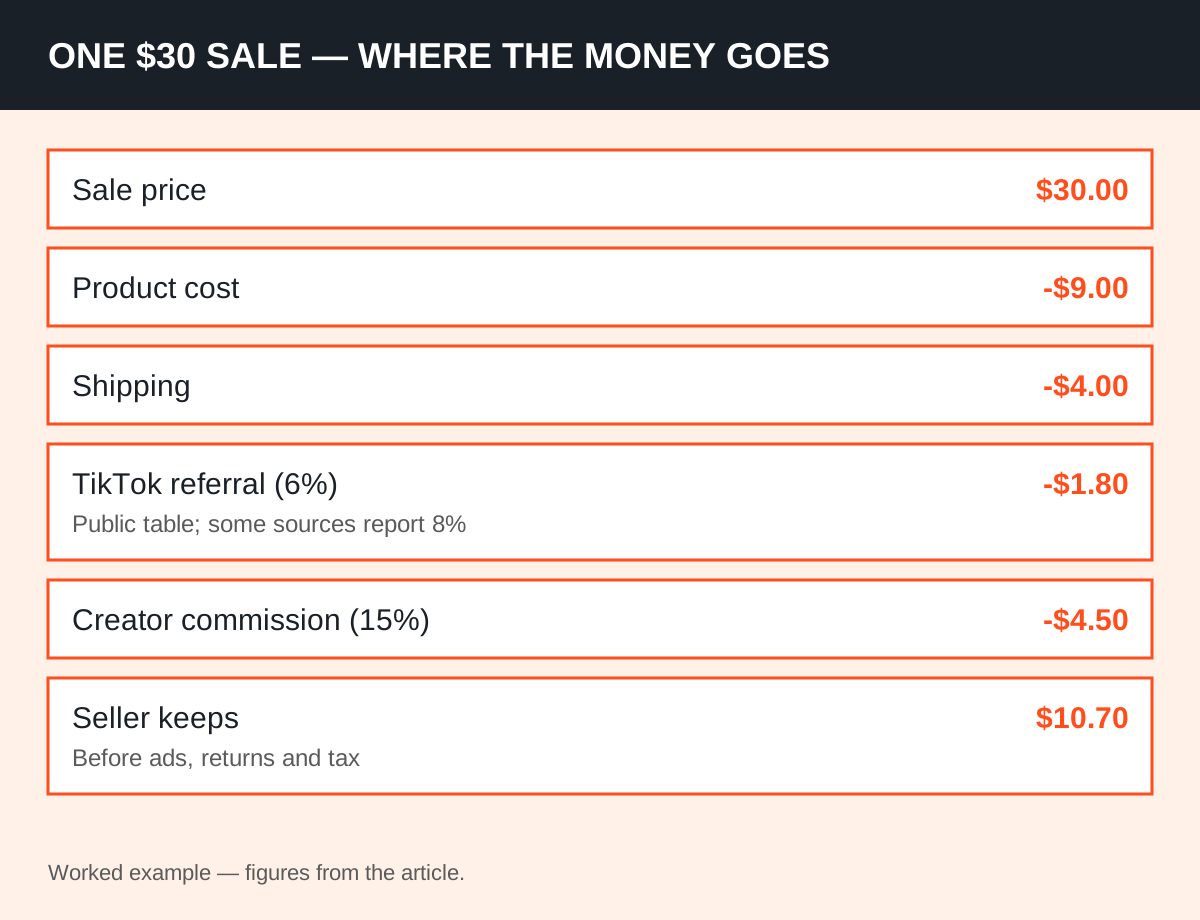
Sellers often quote the commission rate as if it were their only creator cost. It is not, and the full stack is what decides whether a rate is affordable. Work through one sale, with every assumption stated so you can swap in your own numbers. A product sells for 30 dollars. Product cost is 9 dollars.
Shipping is 4 dollars. TikTok's platform referral for most US categories is reported at 6 percent in its public table, with independent seller sources reporting 8 percent from August 2026 — we use 6 percent here and flag the difference, because the platform has not published a single clean number. At 6 percent, the referral is 1.80 dollars.
Creator commission at 15 percent is 4.50 dollars. Subtract all four: 30 minus 9 minus 4 minus 1.80 minus 4.50 leaves 10.70 dollars, before advertising, before returns, and before tax.
That 10.70 dollars is the number your rate decision should be made against. Raise the rate to 25 percent and 7.70 dollars remains; cut it to 10 percent and 12.20 dollars remains — but fewer creators accept at 10 percent, so the volume it multiplies may be much smaller.
Hence the tiered approach used by experienced sellers: a competitive open rate for discovery, a higher rate for proven converters, and a top rate for the handful driving real volume.
One more seller-side fact that changes the negotiation: the creator's commission is not reduced by TikTok's referral fee. They are two separate deductions from the seller's side of the sale. When a creator asks for a higher rate, the cost to you is the full increase; there is no platform discount absorbing part of it.
Price that honestly, and the conversation with creators gets much easier.
When the money actually arrives: settlement, returns and thresholds
The most common budgeting mistake in TikTok Shop affiliate work is treating a sale as income on the day it happens. It is not. The commission sits in a pending state while the delivery and return window runs, and multiple 2026 guides put the release at roughly 14 to 15 days after delivery.
Only after that window clears does the money reach the creator wallet, where it can be withdrawn — with minimum withdrawal thresholds that vary by market, commonly around 10 to 20 dollars.
Returns change the number, not just the timing: a cancellation or return inside the window deducts the commission from the pending balance. A month's headline earnings therefore always overstate banked earnings by the category's return rate — fashion runs far higher than beauty or supplements. Build both budgets on settled, post-return numbers, and treat the pending balance as a forecast.
The cash-flow rule that follows is simple and worth stating plainly: your first month of selling pays you in month two. A creator who starts promoting on day one should not plan to spend affiliate income until roughly six weeks in — the selling period, plus delivery, plus the settlement window.
A seller launching a creator programme should fund sample costs and the first commission run from working capital, not from the sales the creators are about to generate. Neither side is being cheated by this timing; it is the return window doing its job.
But both sides get hurt when they budget as if it did not exist.
From rates to a plan: how many creators does a goal actually take
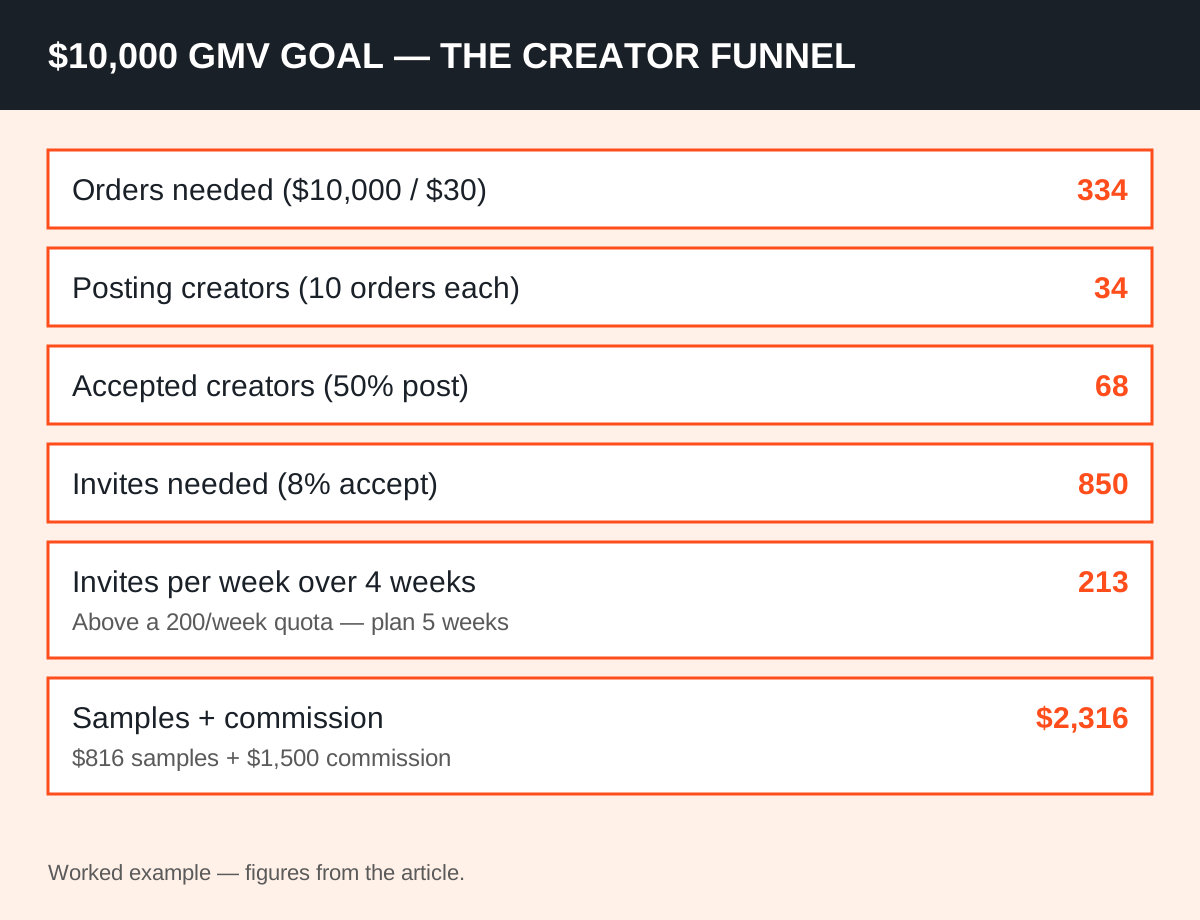
A rate tells you what each sale pays. A plan tells you how many people you need selling. This is where our Creator Calculator earns its place in this article: it turns a monthly GMV goal into a creator outreach plan, step by step, using your own numbers rather than anyone else's averages.
Run its default example and the funnel is brutally clarifying. The goal is 10,000 dollars of GMV in a month. Average order value is 30 dollars. That means 334 orders. At 10 orders per posting creator per month, that is 34 posting creators. If half of accepted creators actually post, you need 68 accepted creators.
At an 8 percent accept rate, you need 850 invites. Over four weeks, that is 213 invites a week — above the example's 200-a-week quota, so the honest answer is five weeks, not four, or a better accept rate, or a higher orders-per-creator assumption that you can actually defend.
Commission enters that funnel through the accept rate, and this is the link sellers most often miss. The calculator does not automatically raise your accept rate when you raise your commission — you enter both numbers, and you should enter them together, honestly.
New shops commonly see accept rates around 2 to 5 percent; established shops with a proven product and a strong commission reach 10 to 20 percent, according to the calculator's own guidance.
So the question "should I offer 15 or 20 percent?" becomes a funnel question: at 20 percent, if your accept rate rises from 8 to 12 percent, the same 68 accepted creators need only 567 invites instead of 850 — and the sample bill falls with it, because samples go to accepted creators.
At 12 dollars of sample cost per accepted creator, 68 accepted creators cost 816 dollars in samples, plus 1,500 dollars of commission on 10,000 dollars of GMV at 15 percent.
That 2,316-dollar creator-related total, before product, shipping and platform fees, is the real cost of the month — and it is a number you can only see once rate, volume and funnel are in the same calculation.
Try it with your own goal: https://learnwithmaneeza.com/creator-calculator/ — change one input at a time and watch which lever moves the invite count most.
The checklist before you pick a product or set a rate
For creators, run this before you promote anything. First, write down the per-sale dollar figure, not the percentage — price times rate, in dollars, is the number you live on.
Second, check the category benchmark and ask whether this product is above or below it, and why; a rate far above its category band is either a launch promotion that will fall or a product with a problem.
Third, estimate monthly sales honestly from your last month of comparable content, not from the seller's pitch deck, and multiply. Fourth, check the return profile of the category, because settled income is what counts.
Fifth, disclose the affiliate relationship clearly in the content — regulators require it, audiences reward it, and it is the cheapest trust you will ever buy.
For sellers: run the section-four stack with your real costs at three rates — planned, five points higher, five points lower — and see which leave a liveable margin after returns.
Set the open rate at the competitive end of your category band, reserve higher tiers for proven converters, and plan the funnel, not just the rate: invite count, sample bill and weekly quota are where programmes fail, quietly, a week at a time.
If you want the full creator programme rather than just the calculator, that is our TikTok Shop team's work: https://learnwithmaneeza.com/service/tiktok-shop-affiliate-growth/ — and our content practice covers the ecommerce content behind the products creators promote: https://learnwithmaneeza.com/ai-tools-ecommerce-content/
The headline rate was never the deal. The deal is the per-sale dollars, the settled dollars, and the number of creators it takes to reach the goal — all three, multiplied together, with the returns taken out. Do that multiplication before you commit, on either side, and TikTok Shop affiliate commissions stop being a guessing game and start being a plan.
Commission by category: what a creator actually earns
Rates only mean something per sale. This table uses the worked examples from this guide.
| Category | Typical open rate | Example | Creator earns per sale |
|---|---|---|---|
| Beauty and skincare | 15-20% | $30 product at 15% | $4.50 |
| Beauty and skincare | 15-20% | $30 product at 20% | $6.00 |
| Electronics | 5-8% | $60 gadget at 7% | $4.20 |
| All categories (2026 average) | Around 13% | Varies by product | Varies |
Model your own product with the TikTok Shop Affiliate Calculator before you set a rate.
Frequently asked questions
What is the average TikTok Shop affiliate commission rate?
There is no TikTok-published average, because sellers set rates per product. 2026 practitioner benchmarks cluster around 13% across US categories, with beauty and skincare higher (roughly 15% to 20% open) and electronics lower (roughly 5% to 8%). Use the category band for the product in front of you, not the platform average, and check the exact rate shown on the product before promoting it.
How much does a creator earn per TikTok Shop sale?
Price multiplied by rate. A $30 product at 15% pays $4.50 per sale; at 20% it pays $6.00. A $45 product at 18% pays $8.10. Work backwards from the monthly income you need: $1,000 a month needs 223 sales at $4.50, 167 sales at $6.00, and 334 sales at $3.00. Volume, not the percentage alone, decides the income.
When do TikTok Shop affiliate commissions actually pay out?
Roughly 14 to 15 days after delivery, once the return window clears — that is the settlement period reported across 2026 guides. Returns inside the window claw the commission back from the pending balance, and minimum withdrawal thresholds vary by market, commonly around $10 to $20. Budget your first month as if it pays in month two.
Should a seller offer a high commission rate to attract creators?
Offer the competitive end of your category band for open collaboration, and reserve higher rates for creators who prove they convert — that tiered shape protects margin while rewarding performance. Run the per-sale stack first: on a $30 sale with $9 product cost, $4 shipping, a 6% platform referral and 15% commission, $10.70 remains before ads, returns and tax. And plan the funnel with the Creator Calculator, because the invite count and sample bill are where programmes actually fail: https://learnwithmaneeza.com/creator-calculator/