The guide
The headline comparison looks like an easy win for TikTok Shop. Its referral fee is 6% on most categories. Amazon charges 15% in most categories. That headline is true, and it is also incomplete. On TikTok Shop, the customer usually arrives through a creator, and that creator is paid a commission you set. On Amazon, the customer usually arrives through search, and you pay for that search with advertising. So the real question is not which fee is lower. It is what a completed sale costs on each channel, including the work of getting the customer there. This guide compares the two channels on the same $50 sale. It uses published US fee rates, checked in November 2026, and it labels every piece of arithmetic as arithmetic. Your category, size and weight will move the exact numbers, but the shape of the comparison will not change much.
Fees, reach and effort side by side: TikTok Shop's 6% referral fee against Amazon's 15%, the creator commission that flips the result, fulfilment on both channels, and a practical way to test both without doubling your costs.
Key takeaways
Why does the headline fee mislead sellers?
Start with the two headline rates, because they are real. TikTok Shop's referral fee page sets the fee at 6% per qualified order, calculated on what the customer pays plus any platform discount, minus tax. TikTok's category table keeps most categories at 6%, with 5% for some jewellery and pre-owned items.
Amazon's side is messier because the rate depends on category. Amazon's own fees guide describes two basic charges: a selling plan and a referral fee on every item sold. Most categories sit at 15%, electronics and computers at 8%, and clothing and beauty use tiered rates that change with price.
Neither headline includes the cost of getting the customer. That cost sits in a different line on each platform. On Amazon it is mostly advertising. On TikTok Shop it is mostly creator commission. Compare the headlines alone and TikTok Shop wins by 9 points. Compare the full sale and the winner depends on your commission rate.
One warning before the numbers. Some seller guides reported in 2026 that TikTok Shop raised its standard US rate to 8% in August 2026. TikTok's public category table still listed 6% in later 2026 checks, and no official announcement confirmed the higher rate.
This article uses the published 6% table rate. Confirm the rate shown in your own Seller Center before you set prices.
What does each platform charge, line by line?
Read this table as the full fee stack, not just the referral fee. Every line is a cost a seller actually pays, and the two channels stack their lines differently.
| Fee line | TikTok Shop (US) | Amazon (US) |
|---|---|---|
| Monthly or subscription | None; no listing fee | $39.99 a month on the Professional plan, or $0.99 per item on the Individual plan |
| Referral fee | 6% most categories; 5% some jewellery and pre-owned | 15% most categories; 8% electronics and computers; tiered clothing and beauty |
| Getting the customer | Creator commission you set, typically 10% to 20% | Advertising (PPC) you set, per click, not per sale |
| Fulfilment per unit | Fulfilled by TikTok from $4.28 for a light single item; $4.52 at 4 to 8 ounces | FBA from about $3.45 for a small standard item, plus a 3.5% fuel and logistics surcharge since April 2026 |
| Returns | Refund administration fee of 20% of the referral fee, capped at $5 per SKU | Return processing and storage rules vary by category and fulfilment method |
| Payment processing | Included in the referral fee on the published US table | Included in the referral fee |
Two lines deserve emphasis. First, TikTok Shop charges no monthly plan, so a slow month costs nothing in subscriptions. Amazon's $39.99 Professional plan is small against real volume, but it is a fixed cost a new seller pays before the first sale.
Second, fulfilment fees are per-unit estimates, not promises. Your exact FBA fee comes from Amazon's Fee Preview for your size, weight and price band, and your exact FBT fee comes from TikTok's rate card for your weight tier. Use the figures in this article to compare channels, not to set a final price.
What does a $50 sale really cost on each channel?
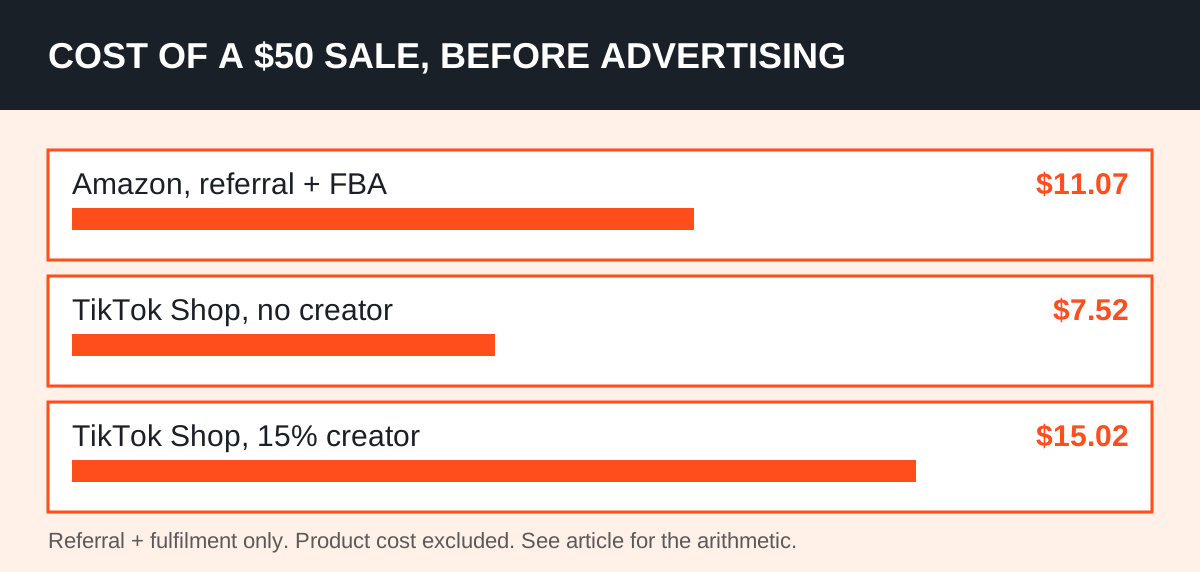
Take one $50 sale and run it through both channels with the same discipline. Product cost and shipping to the warehouse are left out, because they are the same whichever channel sells the unit. What changes is the platform stack.
On Amazon, the referral fee is $7.50 at 15%. Add FBA at $3.45 for a small standard item in the $10 to $50 band, plus the 3.5% fuel and logistics surcharge on that fulfilment fee, which adds about $0.12. The total is $11.07, before advertising, storage and the monthly plan.
On TikTok Shop with no creator, the referral fee is $3.00 at 6%. Add Fulfilled by TikTok at $4.52 for a single 4 to 8 ounce item. The total is $7.52. That is $3.55 cheaper than Amazon on the same sale, before any advertising on either side.
Add a creator at 15% and the picture flips. The commission is $7.50, so the TikTok Shop total becomes $15.02. That is $3.95 more than Amazon's $11.07, again before advertising. The break-even point is a commission of about 7%: at 7%, the creator costs $3.50, which almost exactly eats the $3.55 fee advantage.
That break-even is arithmetic on the cited rates, not a published benchmark. It moves if your fulfilment weight or category changes. But it gives you the right question to ask before you set a commission: is this creator worth more than the fee advantage they consume?
Our guide to TikTok Shop affiliate commissions, explained with real numbers works through commission bands by category, so you can see what rate your category actually needs to attract creators.
How does reach work on each platform?
Reach is where the two channels stop looking alike. Amazon is a search engine with a checkout attached. Shoppers arrive with a product in mind, type it in, compare listings, and buy. Prime membership, reviews and fast delivery do much of the persuading before your listing is even read.
TikTok Shop is the opposite shape. Shoppers arrive to watch videos, not to buy. A creator's video interrupts the scroll, shows the product in use, and links straight to the shop. The purchase is an impulse that the video created, not a search the shopper started.
That difference changes what "reach" costs you. On Amazon, reach is bought click by click, and you only pay when someone clicks. On TikTok Shop, reach is earned video by video, and you only pay a creator when their video actually sells something.
It also changes how long reach lasts. An Amazon listing that ranks well keeps selling while it holds its rank. A TikTok video that performs well sells hard for a short window, then fades as the feed moves on. Amazon reach compounds slowly. TikTok reach has to be rebuilt, week after week, with new content.
Neither shape is better in the abstract. A product people already search for fits Amazon's shape. A product people do not know they want yet fits TikTok's shape. The fee comparison only matters once you know which shape your product lives in.
What effort does each channel demand week to week?
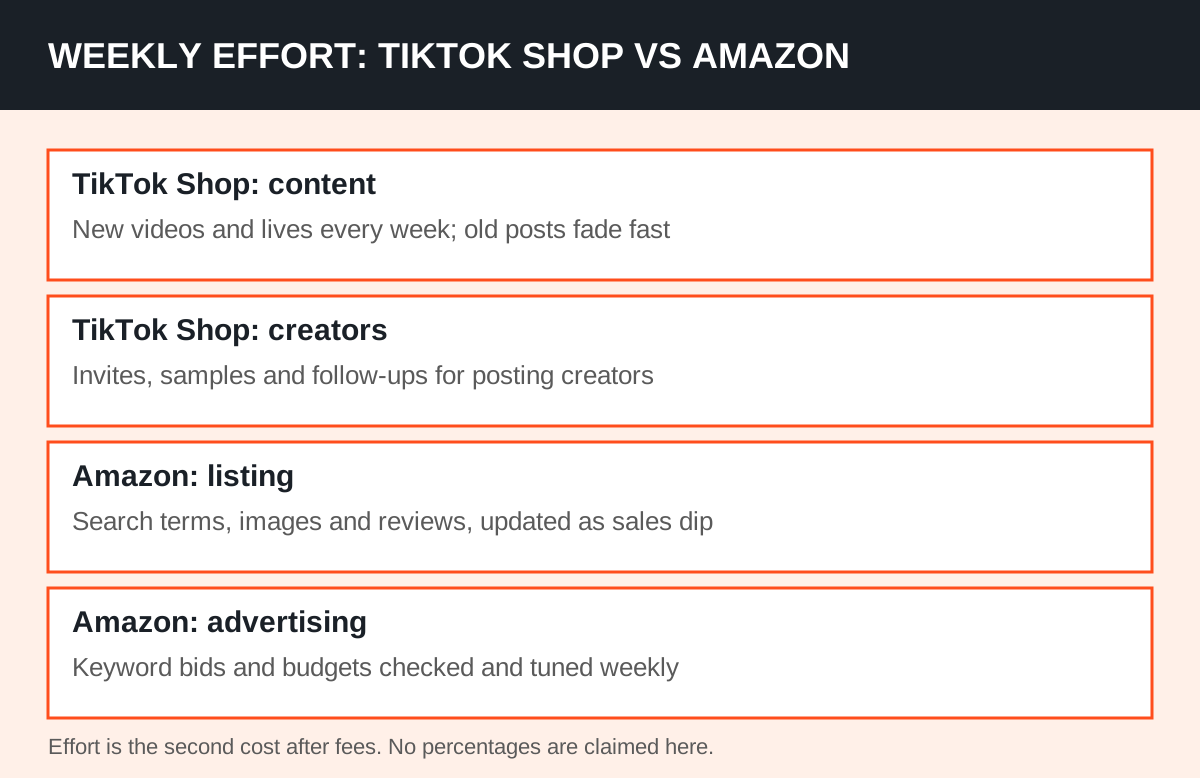
Fees are only half the cost. The other half is your week. TikTok Shop's lower fee buys you a workload that Amazon does not ask for, and sellers who ignore that workload wonder why a cheap channel feels expensive.
On TikTok Shop, the weekly work is content and creators. Someone has to film or brief videos, answer creator messages, send samples, and follow up with creators who accepted but never posted. A shop with no new content this week has no new reach next week. That is the real price of discovery.
On Amazon, the weekly work is listing and advertising care. Someone has to watch search terms, tune bids, protect review health, and update images or copy when sales dip. The work is steadier and less visible, but a listing left alone for months will drift down the rankings quietly.
The effort also falls on different skills. TikTok Shop rewards speed, personality and creator relationships. Amazon rewards patience, keyword discipline and margin control. A seller who loves making content will find TikTok Shop's effort cheap. A seller who hates being on camera will find it exhausting, whatever the fee says.
Be honest about which workload you will actually do. The cheapest channel is the one whose weekly work you will still be doing in six months. Our guide to how much Shopify marketing costs makes the same point for owned stores: a budget that ignores your time is not a budget.
Which channel should you start with, and when should you run both?
Start with the channel that matches how your customer finds you. If shoppers already search for your product type, start on Amazon. Search demand is there on day one, and a good listing converts it without you building an audience first.
If shoppers do not search for your product yet, start on TikTok Shop. A creator showing the product in use can create demand that search never would. That is especially true for beauty, novelty, home and impulse-priced products, where seeing the product matters more than reading about it.
Run both when one channel is already paying for itself. The second channel then gets funded by the first, not by hope. Use Amazon for steady search sales and TikTok Shop for bursts of discovery, and let each channel cover the other's weak weeks.
Before you commit a commission rate, model the creator funnel, not just the fee. Our TikTok Shop Creator Calculator turns a monthly sales goal into the creator numbers behind it: orders needed, posting creators needed, invites needed, and the sample bill.
Run it at your planned commission, then five points higher and five points lower, and watch which rate still leaves a liveable margin after the platform stack in section 03.
That funnel check is where most TikTok Shop plans fail quietly. The commission looks affordable per sale, but the invite count and sample bill behind it are not. A rate that wins creators and still leaves margin is the only rate worth setting.
How do you test both without doubling your costs?
Do not launch fully on both channels at once. Test one product, on both channels, for one honest month, with the same price and the same margin target. One product keeps the test cheap, and one month is long enough for Amazon search to settle and TikTok videos to cycle.
On Amazon, the test is a listing plus a small, capped advertising budget. Judge it on search conversion and on cost per sale after advertising, not on clicks. If the listing converts but advertising eats the margin, the product needs a better listing or a higher price, not a bigger budget.
On TikTok Shop, the test is a small creator group, not a big launch. Invite twenty creators, send samples only to those who accept, and set the commission at the competitive end of your category band. Judge it on sales per posting creator and on the sample bill per sale, not on views.
At the end of the month, compare the two channels on the same measure: profit per sale after the full stack, including your time. Keep the channel that clears your margin target with the workload you will sustain. If both clear it, keep both, and let the break-even ROAS guide discipline your advertising on each side.
If neither clears it, the problem is usually not the channel. It is the price, the product cost, or a commission rate set to win creators at any cost. Fix the unit economics first. A channel change will not rescue a sale that loses money on every order.
If you want help running that test as one programme rather than two separate launches, our TikTok Shop affiliate growth service covers creator programmes alongside the wider ecommerce work, so the test and the scale-up use the same numbers.
Frequently asked questions
Is TikTok Shop cheaper than Amazon for sellers?
On the platform fee alone, yes: TikTok Shop charges 6% referral on most US categories against Amazon's 15% in most categories. Once creator commission is added, the answer flips at about a 7% commission on a $50 sale, so the cheaper channel depends on the commission rate you set.
What is TikTok Shop's referral fee in 2026?
TikTok Shop's published US category table lists 6% for most categories, with 5% for some jewellery and pre-owned items, and 3% on the portion above $10,000 for qualifying pre-owned and collectible sales. Some 2026 guides reported an 8% rate from August 2026, but TikTok's public table still listed 6% in later checks, so confirm the rate in your own Seller Center.
What does Amazon charge on top of its referral fee?
Amazon charges a selling plan ($39.99 a month Professional, or $0.99 per item Individual), plus optional FBA fulfilment per unit, storage, and advertising per click. Referral fees are 15% in most categories, 8% on electronics and computers, with tiered rates on clothing and beauty and a $0.30 minimum on most categories.
Should a new seller start on TikTok Shop or Amazon?
Start where your customer already looks: Amazon if shoppers search for your product type, TikTok Shop if the product needs to be seen in use before anyone searches for it. Test one product on both for a month at the same price, compare profit per sale after the full fee stack, and keep the channel whose workload you will sustain.