The guide
For two years, marketers asked when ChatGPT ads would arrive, and whether they would ruin the answers. In 2026, both questions got an answer. The ads arrived, testing first in the United States for logged-in adults on the free and low-cost plans, and they arrived with a hard design line: a sponsored placement sits below the answer, clearly labelled, and — in OpenAI's repeated position — advertising does not influence what ChatGPT says. That line is the whole story, because it creates two separate ways to appear in a ChatGPT conversation, and confusing them is the most expensive mistake an advertiser can make this year. The first way is paid, and you can buy it. The second is earned, and you cannot: it is the recommendation inside the answer itself, which comes from what the model can read, verify and cite about your business. This guide covers the paid side: what the formats actually are as of late October 2026, where they appear, how targeting works without keywords, and the one switch OpenAI is flipping at the end of this month that you need to decide on before it flips for you. It ends with a four-week prep plan you can run with a small test budget. The honest reason to move now is not that ChatGPT ads are proven. It is that they are still new, still lightly contested, and still cheap enough to learn on — and that learning will be worth far more next year than it is today.
Buy the slot, earn the answer. What ChatGPT ads are, where they show up, the creative-enhancements switch landing on 29–30 October, and a four-week plan to test them without handing your brand over to an algorithm.
Key takeaways
What a ChatGPT ad actually is, and what it is not
A ChatGPT ad is a sponsored placement that appears in a ChatGPT conversation, clearly labelled as sponsored and visually separated from the answer above it. The typical unit is small: an advertiser name, a headline, a short line of body copy, an image or product card, and a destination link.
There is no video, no takeover, and no interruption mid-answer. The ad waits until the answer is finished, then appears beneath it, when the conversation has commercial intent and a relevant product exists to show.
What it is not matters more. It is not a recommendation, and buying one does not make ChatGPT name your brand in its answer. OpenAI repeats this as answer independence: ads run on separate systems from the chat model, they are labelled, and advertisers cannot shape, rank or alter the response.
OpenAI documents its advertising policies and formats in the OpenAI Help Center.
Your paid and earned plans are different jobs: the paid job wins the slot with a clear offer, while the earned job makes your business citable enough that the answer itself names you — see our guide to checking whether ChatGPT can see your business: https://learnwithmaneeza.com/check-if-chatgpt-can-see-your-business/ — and that job does not get easier because you bought an ad.
ChatGPT is a discovery layer, not a checkout: the purchase still happens on your site.
The timeline so far: how fast this moved
ChatGPT ads arrived as a staircase, not a single launch. Testing began in the United States for logged-in adults, then a self-serve Ads Manager opened, adding cost-per-click bidding alongside the original cost-per-thousand-impressions options.
The footprint then widened region by region — Europe in August, Southeast Asia and Taiwan in September — and trade reporting on OpenAI's 21 October 2026 expansion put the total at 89 countries with more than 100,000 cumulative advertisers since launch. Read that second figure carefully: it is cumulative, not a live count of active advertisers today.
It tells you about growth, not about how crowded your category is. Only a test in Ads Manager will tell you that.
The most recent format news is the visual ad. On 5 October 2026, OpenAI announced it would test visual ads during image generation later in October, in the United States, with an initial group of advertisers.
The format shows product inspiration, products in use, or experiences a service offers, beside the image being generated — not inside it — and OpenAI says it will be clearly labelled, with the same answer-independence line.
No global rollout date or frequency details have been announced, so treat confident claims about how often these ads will appear as speculation. Then, on 20 October 2026, OpenAI emailed self-serve advertisers that creative enhancements would switch on by default for new and existing campaigns.
The email gave Friday 30 October 2026; the help page, checked days later, gave Thursday 29 October. That discrepancy is worth noting: details are still moving, and advertisers who check their own Ads Manager settings will know more than those who read a summary.
Section 05 returns to that switch, because it is the one decision here with a deadline.
Where your ad can actually appear
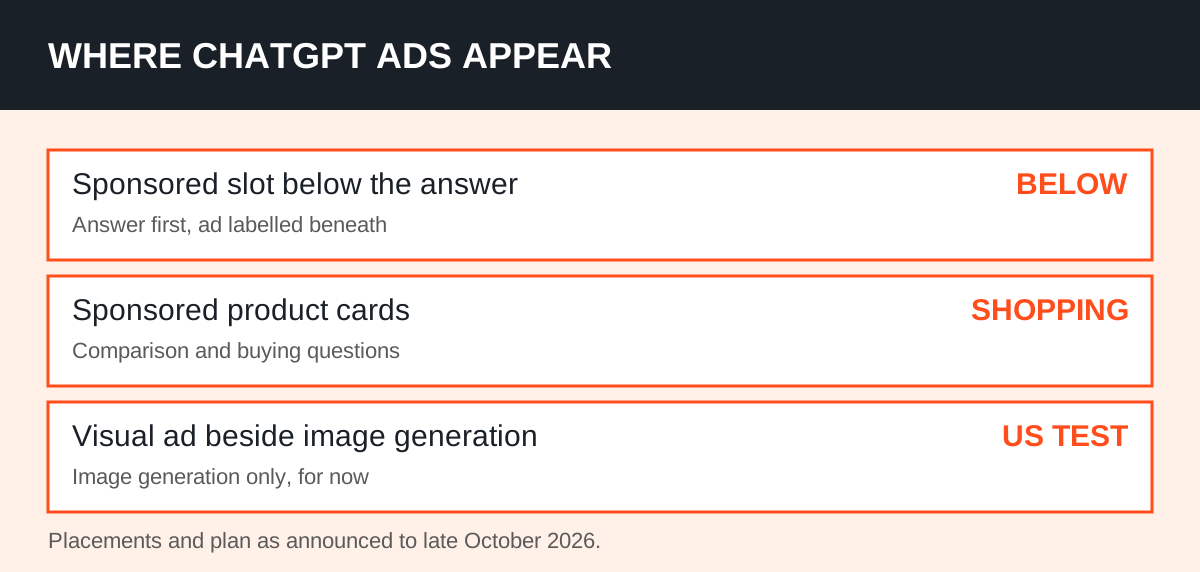
Think of ChatGPT ads as three placements on one funnel, not one format with three names.
- The sponsored slot beneath a conversational answer — the core placement. A user asks a buying-intent question, ChatGPT answers, and below that answer sits a labelled sponsored card. This is the closest analogue to paid search: intent expressed, offer shown, click to a page that should close the sale.
- Sponsored product cards on shopping questions — when a user asks a comparison or buying question, sponsored cards can appear in that shopping context, in a form familiar to anyone who has run Google Shopping. The organic product results in that surface are, per OpenAI's shopping help material, selected independently and are not ads. For a retailer, the feed behind the card matters more than the card: current prices, current stock and honest descriptions decide whether your card deserves the click.
- Visual ads beside image generation — the new test format, for now a United States test with an initial advertiser group. A visual ad appears beside the image being created while the user waits for their own image to render. The example OpenAI published shows a grocery brand's product images with a learn-more action during an image request. The user here is imagining, not yet comparing, so the ad's job is to plant a brand in that imagination rather than close a sale. Judge it on consideration, not last-click sales in week one.
Two guardrails are constant: no ads to Plus, Pro, Business or other paid plans, or to accounts identified as under 18; and no ads in conversations OpenAI classes as sensitive or unsuitable, such as health, mental health and politics. If your business sits near a sensitive category, check its advertising policies first — a placement that never serves is a category problem, not a targeting problem.
How targeting really works, without keywords
The first thing to unlearn is the keyword. ChatGPT ads have no keywords to bid on, and that is not a missing feature; it is the design.
Instead, you give OpenAI context hints — descriptions of the conversations and topics where your product might be relevant — and the system matches your ad to a conversation based on its topic, its intent, and, where the user has personalisation switched on, selected signals from their broader ChatGPT experience.
These hints are not exact-match keywords, and they do not guarantee you will appear in any specific conversation. If your media plan is built on owning a query, rewrite it. In ChatGPT, you own a context, and contexts are broader and messier than queries — which is both the opportunity and the trap.
That changes creative. A paid-search ad answers a query; a ChatGPT ad enters a conversation, mid-thought, possibly three turns into a comparison, and the ad that wins fits the thought, not a keyword.
Write headlines that complete a sentence the user is already thinking — the use case, the constraint, the trade-off — and landing pages for a visitor with a half-formed question, not a fully-formed intent. Added controls — US geo targeting, platform targeting, gated custom audiences — do not turn this into a Meta-style behavioural product.
The dominant signal remains what the person is asking right now.
The October switch: creative enhancements, and the decision you must make first
Here is the deadline in this guide, and it lands within days of publication. OpenAI told self-serve advertisers on 20 October 2026 that creative enhancements would be enabled by default for new and existing self-serve campaigns, starting 30 October according to the email and 29 October according to the help page.
With enhancements on, OpenAI's system can rewrite your headlines and descriptions to tie the offer to the conversation, translate the ad text, resize images, and optimise the destination URL — sending the click to a different, more relevant page on your own site.
Variations can be prepared in advance or generated in real time, and the versions that run do not need your approval first.
That is a genuine trade, not a free upgrade. The upside: an ad rewritten for the conversation should fit it better than one fixed headline.
The downside is control: the version a user sees may be one you never read, and in a regulated or claim-sensitive category, a wrong word is a legal or reputational problem. Decide before the switch, in this order. First, open Ads Manager and find the setting for every live and draft campaign.
Second, split campaigns into low-risk ones, where a rewritten headline is a learning opportunity, and claim-sensitive ones, where an unapproved word is a liability. Third, opt the second group out before the end of October, and keep the first group opted in as your controlled test, noting what you changed and when.
Fourth, use the Negative Phrases option to exclude placements that conflict with your brand policies, and revisit it monthly. If an agency runs your ads, ask for written confirmation of which campaigns were left opted in and which were opted out, and why.
Measurement without fooling yourself
The measurement story is better than at launch and still thinner than a mature channel, and planning around both halves is the skill.
On the better side, the October announcements added a real layer: Ads Manager for budgets, creative and performance; cost-per-click bidding alongside cost-per-thousand-impressions; conversion-data integrations with Hightouch, Tealium and LiveRamp; attribution partners including AppsFlyer, Adjust, Branch, Singular and Kochava; and brand-suitability pilots with DoubleVerify and Integral Ad Science that OpenAI says run in controlled environments without access to real user conversations.
That is a usable stack for a test: you can see clicks, connect conversions from your own data, and run geo-based incrementality experiments.
On the thinner side, early reporting has been described as weekly impressions-and-clicks summaries, and the platform's dashboard will always flatter its own ads. Treat OpenAI-cited early results the same way: hand-picked claims, not benchmarks. WeightWatchers was cited at about 15 percent lower cost per acquisition than blended paid search; Portland Leather at about 93 percent new visitors.
Those may be true for those advertisers, in those weeks — and tell you almost nothing about your first month. Do not put them in a forecast. Judge a test on three hard-to-flatter numbers: incremental revenue or leads measured by a holdout, blended efficiency, and new-customer rate and downstream value.
Set them before launch, and review at 30 and 60 days.
Your four-week prep plan, and where to start

Week one is a free audit. Run the earned-side check first: ask ChatGPT the buying questions your customers actually ask, and see whether your business appears, accurately, and cited.
That is the check our guide walks through — https://learnwithmaneeza.com/check-if-chatgpt-can-see-your-business/ — and it matters before you spend a dollar on ads, because the ad and the answer will sit on the same screen. If the answer misdescribes you, fix the pages, feeds and listings behind it first.
While you are there, open Ads Manager, confirm account and billing, find the creative-enhancements setting, and make the opt-in and opt-out decisions from section 05 in writing.
Week two is assets, built for conversations. Write three headline and body combinations per offer, each fitted to a different conversation shape: the comparison shopper, the constraint shopper, and the use-case shopper.
For each, name the landing page it should land on — not the homepage, the page that answers that conversation — and check that it loads fast, states price and terms plainly, and lets a buyer act without hunting.
If you sell products, check the feed behind any product card with the same care: current prices, current stock, honest descriptions. Then write your Negative Phrases list before you need it.
Week three is a small test: one campaign, one offer, one holdout geo, with a budget you can afford to learn on for 30 days, creative enhancements on for this campaign only. Watch what headlines served and where clicks landed. Week four is the decision.
Compare the holdout against the test geo on blended efficiency and new-customer value, not platform clicks. If the channel added demand, scale the winning conversation shapes and landing pages.
If it mostly reattributed existing demand, keep it as a small defensive presence and put the growth budget back into the earned side — the content, feeds and reviews that get you named in the answer itself. Either outcome is a win, because you learned it for the price of a test.
And if the test raises a question about where paid social, search and ChatGPT ads should sit together, check the earned side with our AI Visibility Snapshot: https://learnwithmaneeza.com/ai-visibility/ — and talk paid social with our team: https://learnwithmaneeza.com/service/paid-social-ppc/ — bring the holdout numbers.
Frequently asked questions
Can you pay ChatGPT to recommend your business?
No. You can buy a labelled sponsored slot that appears below ChatGPT's answer, but you cannot buy a place inside the answer itself. OpenAI says advertising does not influence ChatGPT's responses, and that its organic product results are selected independently and are not ads. The recommendation inside the answer has to be earned — through accurate pages, current feeds, reviews and content the model can cite.
Who actually sees ChatGPT ads?
Logged-in adults on the free and Go plans. Users on Plus, Pro, Business, Enterprise and Education plans do not see ads, and ads are not shown to accounts identified as belonging to users under 18. Ads are also kept out of conversations OpenAI classes as sensitive or unsuitable, such as health, mental health and politics. Your most engaged, paying ChatGPT users are therefore outside the ad audience — plan for that.
What are creative enhancements, and should I leave them on?
Creative enhancements let OpenAI's system rewrite your headlines and descriptions for the conversation, translate ad text, resize images and send clicks to a more relevant page on your site, without approving each version with you first. They switch on by default for self-serve campaigns at the end of October 2026 (30 October in OpenAI's email, 29 October on its help page). Leave them on for low-risk test campaigns to learn what they do, and opt claim-sensitive or regulated campaigns out before the switch.
How much should I budget for a first ChatGPT ads test?
Budget what you can afford to learn on for 30 days, not what you need to win in week one. No reliable public benchmark exists for a first test, and OpenAI-cited early results from hand-picked advertisers are not a forecast for your category. Run one campaign, one offer and one holdout geo, judge it on blended efficiency and new-customer value at 30 and 60 days, and scale only the conversation shapes and landing pages that beat the holdout.