
The guide
A business owner gets two quotes for the same Google Ads account. One agency asks $750 a month flat. Another asks 15% of ad spend, which works out to $1,500 on a $10,000 budget. Both quotes can be fair. Both can also be a bad deal. The difference is not the number. It is what sits behind it: how many keywords, how many channels, who writes the ads, and whether the reporting tells you anything. This guide puts real numbers on PPC management pricing. It covers the four models agencies use and a published rate card at three spend levels. It also covers freelancer rates for comparison, and the questions that separate a fair fee from an expensive lesson.
The four pricing models, a published rate card at $2,000, $10,000 and $50,000 a month of spend, freelancer rates from Upwork, and the six questions to ask before you sign.
Key takeaways
What does "PPC management" actually cover?
Before comparing prices, agree on what the price buys. "PPC management" sounds like one job, but it is six jobs bundled together.
Virtustant's roundup of agency pricing pages lists the six. They are account structure, keyword and search-term work (including negatives and a weekly search-terms review), ads and landing pages, bids and budgets, conversion tracking, and reporting.
Clutch's PPC pricing guide lists the same work in its own words. Its list covers ad copywriting and ad design, ad spend management, bid management, audience and keyword research, reporting and metrics optimisation, conversion tracking, and landing page creation.
Two things are usually NOT in the fee. First, the ad spend itself — Google and Meta bill your clicks separately, and that money never passes through the agency's margin. Second, new landing page builds: most agencies flag leaky pages, but building a new one is a separate line.
That is the first test of any quote. If the proposal does not list the six jobs, you cannot tell whether $750 is a bargain or a skeleton service. Ask for the list in writing before you compare numbers.
Our guide to how much Google Ads cost in 2026 covers the ad-spend side of the same budget. Keep the two numbers separate in your head.
The four pricing models, and what each one costs
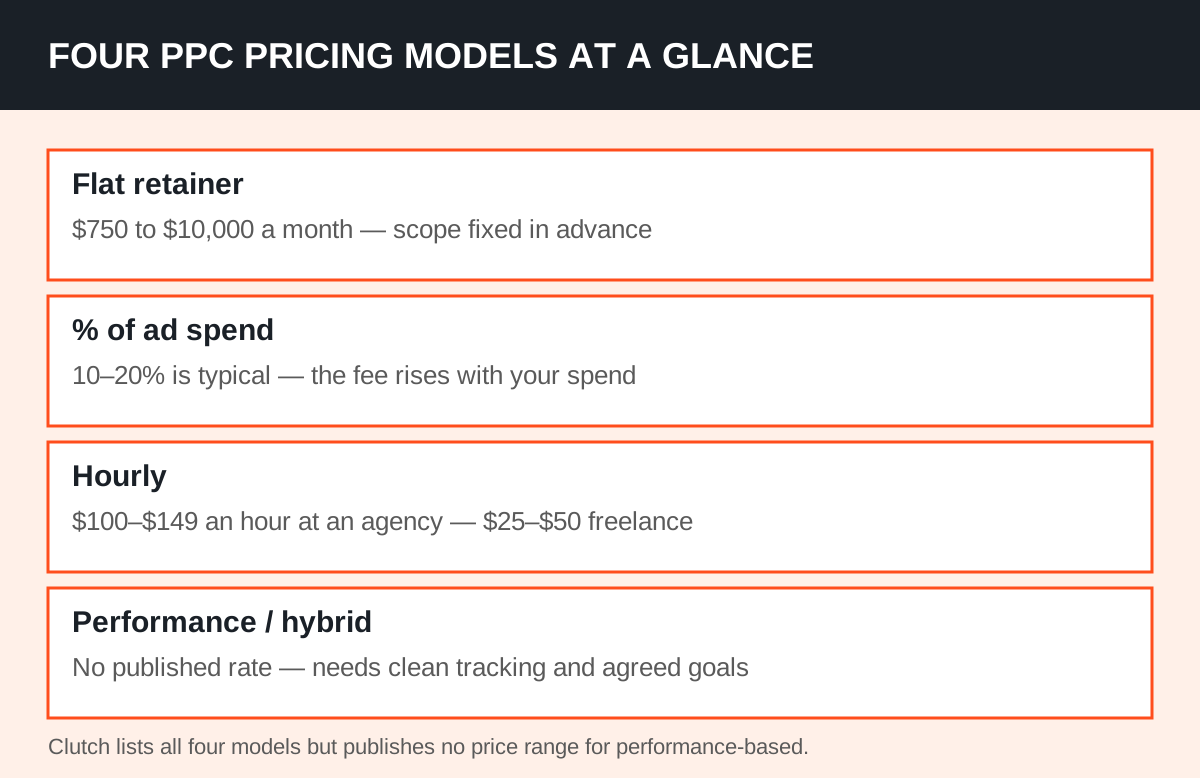
Agencies price the same six jobs in four different ways. The model matters as much as the number, because it decides whose interests the fee follows.
| Model | Typical range | Best for | Watch out for |
|---|---|---|---|
| Flat monthly retainer | $750–$10,000 a month | Predictable budgets, one or two channels | Scope creep — check what is actually included |
| % of ad spend | 10–20% of spend | Growing budgets, multi-channel accounts | Fee rises with spend even if results do not |
| Hourly | $100–$149 an hour (agency) | One-off audits and fixes | Hours can balloon without a cap |
| Performance / hybrid | No published rate | Accounts with clean tracking | Needs agreed definitions of a lead or sale |
The flat retainer is the simplest to budget. WebFX's Lite tier is $750 a month flat, and Sagely's 2026 roundup puts flat retainers at $1,500–$10,000 a month depending on scope. Small accounts sit at $1,500–$3,000; larger, more complex accounts at $3,000–$8,000.
The percentage model is the most common. WebFX puts management fees at typically 10–20% of ad spend, or around $1,000–$3,000 a month. The percentage usually falls as total spend rises. The ppc.io pricing guide calls 12–30% of monthly ad spend the standard convention in 2026.
Hourly pricing is common for one-off work. Clutch's 2026 guide puts most PPC agencies at $100–$149 an hour. Freelancers are far cheaper per hour, which section 04 works through.
Performance pricing sounds attractive — pay for results. Clutch lists it as one of the four models but publishes no price range for it. Virtustant notes that none of the pricing pages it checked publishes a performance price either. It only works when conversion tracking is clean and both sides agree what counts as a lead.
What you pay at three spend levels
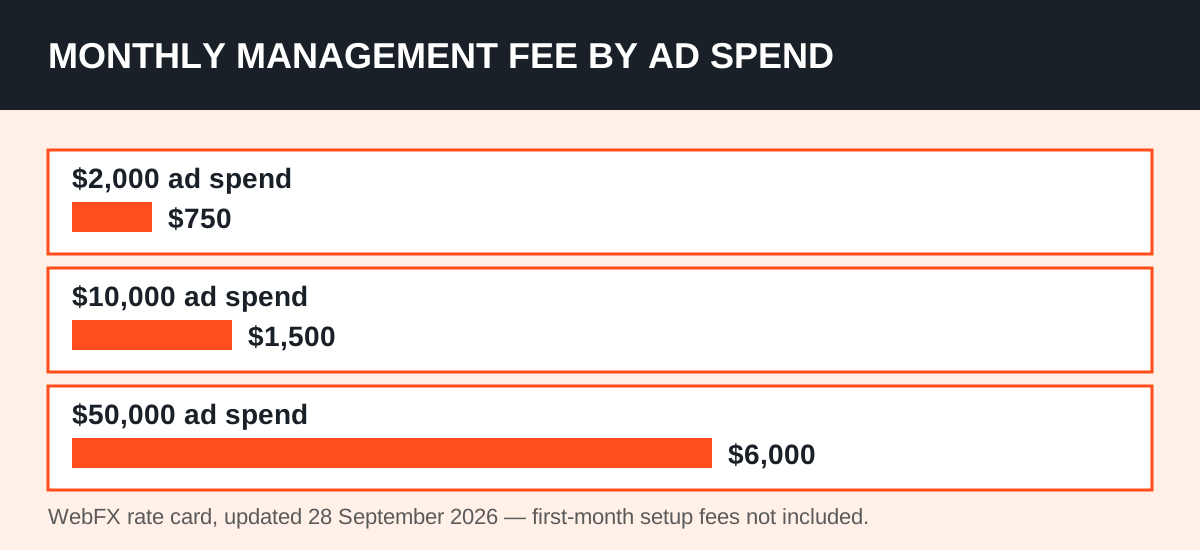
A percentage fee is hard to judge in the abstract, so here is one published rate card worked through at three spend levels. WebFX publishes its tiers openly, updated 28 September 2026.
| Monthly ad spend | WebFX tier | Management fee | First month (incl. setup) |
|---|---|---|---|
| $2,000 | Lite | $750 flat | $1,200 |
| $10,000 | Pro | $1,500 (15% of spend) | $2,250 |
| $50,000 | Enterprise | $6,000 (12% of spend) | $5,800 |
The arithmetic: Pro is "$975 or 15% of spend, whichever is higher" — at $10,000, 15% is $1,500, so the percentage applies. Enterprise is "$4,500 or 12%, whichever is greater" — at $50,000, 12% is $6,000.
Two patterns matter. First, the percentage falls as spend rises: 15% at $10,000, 12% at $50,000. Second, the flat fee is the floor. At $5,000 of spend, Pro costs $975 a month, not $750. That is because 15% of $5,000 is $750, and the $975 floor is higher.
Read the table as a benchmark, not a quote. Your agency's numbers will differ. But the shape should look familiar: a floor at low spend, a percentage in the middle, and a lower percentage at high spend. A quote that breaks that shape — say, 20% at $50,000 a month — deserves a question.
Freelancer or agency? The honest comparison
The cheapest way to buy PPC management is a freelancer. Upwork's PPC specialist rates page puts entry-level specialists at $20–$25 an hour, intermediate at $25–$35, and experts at $35–$45. Freelancers typically charge $25–$50 an hour.
Ten hours a week at $40 an hour is roughly $1,730 a month (arithmetic). That buys a competent specialist for one channel and a modest spend — often the best value a small business can get.
An agency costs far more per hour. Clutch's guide puts most PPC agencies at $100–$149 an hour. A typical project runs $10,000–$49,999, and the average monthly cost is $7,165.33 across the firms it surveyed.
The gap buys a team, not just hours. An agency brings a strategist, a copywriter, a designer and a tracking specialist to the same account, plus cover when one person is away. A freelancer brings one brain and one pair of hands.
Choose the freelancer when you run one channel, spend under about $10,000 a month, and can brief and review the work yourself.
Choose the agency when you run several channels. It also fits when you need creative and landing pages as well as media buying, or when you spend enough that a single point of failure is a business risk.
The costs nobody puts in the headline
The management fee is only one line of the real budget. Four more lines sit beside it, and they surprise first-time buyers.
First, the ad spend itself. Google charges per click, and clicks are not cheap. WordStream's 2026 benchmarks put the all-industry median Google Ads cost per click at $5.42, with a median cost per lead of $66.69. At $5.42 a click, $1,000 of spend buys about 184 clicks (arithmetic).
Second, the setup fee. WebFX charges a first-month fee that includes a campaign audit: $1,200 on Lite, $2,250 on Pro and $5,800 on Enterprise. Expect a setup line on any serious quote — the question is what it delivers, not whether it exists.
Third, the add-ons. On WebFX's own card, social media advertising is $975 a month extra. Landing page testing is $1,800 a month, call tracking is $100 a month, and an extra language is $325 a month. The headline fee rarely covers everything the account needs.
Fourth, the minimums. Google itself sets no minimum — you can start at $1 a day. But WebFX recommends $1,000–$3,000 a month to gather meaningful data for testing.
WordStream suggests $3,000–$10,000 over about 90 days to judge whether PPC works for a business. Mayple, a vetted-freelancer platform, only takes companies investing at least $5,000 a month in marketing.
Add the lines up before you sign. A $750 fee on a $2,000 budget is really a $2,750 monthly commitment before setup. Knowing that upfront is what stops the budget argument in month two.
Before you judge any fee, work out what a lead is worth to you. Our break-even ROAS calculator turns your margins into the cost per lead you can actually afford. That number, not the agency's rate, decides whether the fee pays.
What you actually get at each tier
The fee only makes sense against the inclusions list. WebFX publishes its tiers in detail, and they show how sharply the service changes with price.
Lite, at $750 a month, covers Google PPC only. It includes audit and strategy, keyword targeting, ad creatives, bid management, performance testing, click-fraud monitoring, GA4 integration, and monthly reporting. It also includes 2,000 keywords and up to two consultations a month.
Pro, at $975 or 15%, adds Bing, remarketing, Google Shopping, audience matching, ChatGPT ads and Yelp. It also brings 10,000 keywords, a custom landing page template, display ad creatives, call tracking and website conversion analysis.
Enterprise, at $4,500 or 12%, adds more display creative sets, a 30-second connected TV ad alongside the 15-second one, and a larger call-tracking pool.
Notice what changes between tiers: channels, keyword volume, creative volume, and tracking depth. The work itself — the six jobs from section 01 — is the same at every tier. You are paying for breadth and volume, not for a different craft.
One more thing to check: reporting cadence. WebFX lists monthly performance reporting on all tiers, with up to two personal consultations a month. No weekly reporting is promised at Lite. A good report shows search terms, negatives added, tests run, and cost per lead explained in plain language. If a proposal promises weekly reporting, ask who writes it.
Six questions to ask before you sign
Price comparisons end here. The last step is a short interview — six questions, asked of every provider, in writing.
What exactly is included — and what is an add-on? Get the six jobs listed, then ask which ones cost extra. Landing pages and creative are the usual surprises.
Who owns the ad account, the data and the creatives if we part ways? Your account should live under your ownership, with the agency as a manager. Losing your account history on exit is the most expensive clause in a cheap contract.
How is the fee calculated when spend changes? If the fee is a percentage, ask about the floor and whether the percentage drops as spend grows. If it is flat, ask what spend band the flat fee covers.
What does reporting look like, and how often? Ask for a sample report. Monthly is the norm; weekly is a premium. Either way, the report should name the tests run and the lessons, not just the spend.
What is the minimum term, and what is the exit? Some agencies ask for six to twelve months. A long term is fine if the inclusions justify it — but know the exit cost before you need it.
What does success look like in 90 days — and how is it measured? The answer should be a number: cost per lead, return on ad spend, or a named conversion volume. "More traffic" is not a target.
Red flags: guaranteed results, no access to your own account, and a percentage fee with no floor or cap discussed. A setup fee with no audit deliverable attached is another. Any one of those is a reason to get a second quote.
If you would rather hand the whole job to a team that prices it openly, our paid social and PPC service starts with an audit of your account. The fee is then sized to the work your account actually needs, not to a tier on a page.
Frequently asked questions
How much does PPC management cost per month?
For a small business, expect roughly $750 to $3,000 a month in management fees, or 10–20% of ad spend (WebFX, updated 28 September 2026). Enterprise accounts pay $4,500 a month or 12% of spend. The ad spend itself is billed separately by Google or Meta.
Is PPC management charged as a percentage of ad spend?
It is the most common model: 10–20% of monthly ad spend is typical, often with a flat floor (for example $975 a month) and a lower percentage as spend grows. Flat retainers and hourly billing are the main alternatives, and performance-based pricing has no published standard rate.
Should I hire a freelancer or an agency for PPC?
A freelancer costs $25–$50 an hour on Upwork (experts $35–$45) and suits one channel and spend under about $10,000 a month. An agency costs $100–$149 an hour (Clutch, 2026) and suits multi-channel accounts that also need creative, landing pages and tracking depth.
What is a good PPC management fee for a $5,000 monthly budget?
On WebFX's published card, a $5,000 budget sits on the Pro tier at $975 a month, because 15% of $5,000 is $750 and the $975 floor is higher. Flat retainers for that size run about $1,500–$3,000 a month — plus the $5,000 ad spend itself and a one-off setup fee.