The guide
Every AI ad tool promises the same thing: more ads, faster, for less money. Every one of them prices that promise differently. One charges per download. One charges per fifteen seconds of video. One charges per generation. One charges per started minute of talking actor. Compare their monthly plan prices and you learn almost nothing. Compare what one finished, usable ad costs on each, and the ranking flips. This guide compares four tools that cover the real spread of the category: AdCreative.ai for scored static ads, Creatify for AI-presenter video, Pencil for generation plus a performance prediction, and Arcads for realistic AI actors. Prices come from independent October 2026 reads of vendor pages. Where a figure is our arithmetic, it says so.
Pricing and output side by side: what each tool makes, what its meter charges, what one finished ad really costs once retakes are counted, and which tool fits a solo store, a testing-heavy advertiser, and an agency.
Key takeaways
Why does the plan price mislead you?
Start with the trap. A $14 plan next to a $249 plan looks like an easy decision. It is not, because the two plans do not sell the same unit.
AdCreative.ai sells downloads. You can generate unlimited variations and pay only when you download a finished creative. Pencil sells generations: each attempt counts, kept or not. Creatify sells seconds of video, rounded up into fifteen-second blocks. Arcads sells minutes of talking actor, rounded up to the full minute.
A plan price tells you what the subscription costs. It tells you nothing about how many usable ads that subscription produces. That number depends on the meter, on how many attempts you throw away, and on whether revisions are billed. This guide prices the ad, not the plan.
One more warning. These vendors reprice during the year, sometimes during the month. AdCreative.ai's credit counts changed in mid-October 2026, and Creatify's plan ladder changed between September and October reads. Treat every figure below as a November 2026 snapshot, and confirm the meter on the vendor's page before you commit to a year.
What do the four tools cost, side by side?
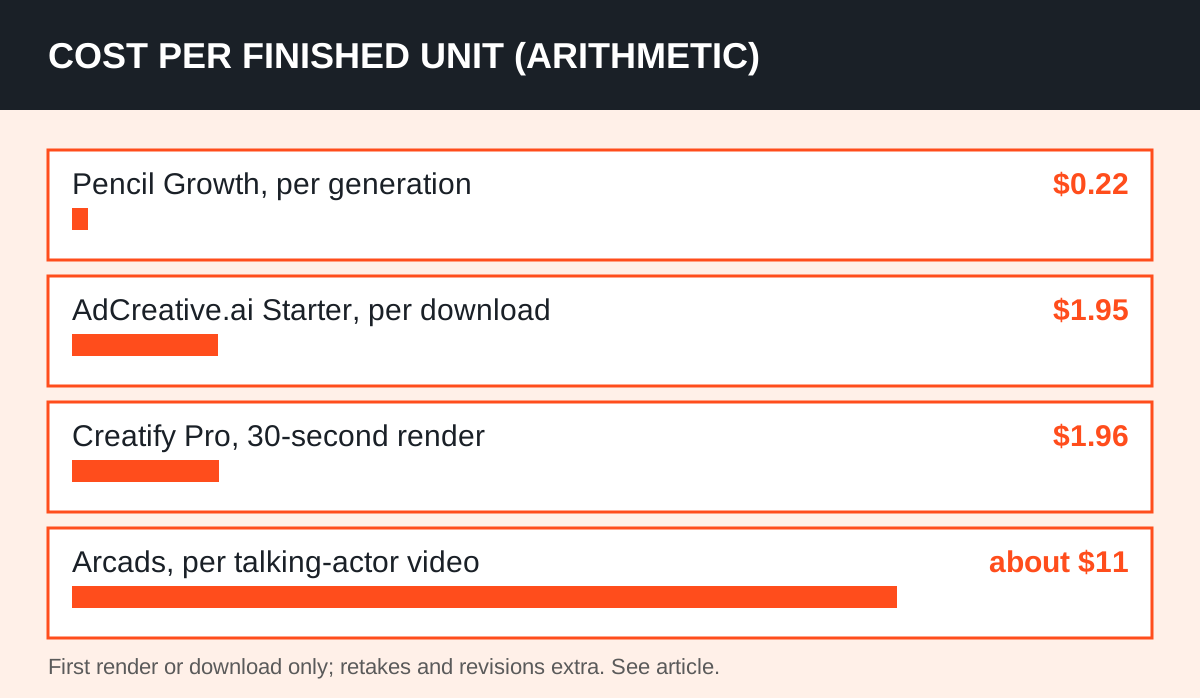
Here are the four tools on the same basis: entry plan, monthly billing, and the cost of one unit under that plan's meter. All per-unit figures are arithmetic from the published price and meter, not vendor quotes.
| Tool | What it makes | Entry plan (monthly) | Meter | Cost per unit (arithmetic) |
|---|---|---|---|---|
| AdCreative.ai | Scored static ads, banners; video on higher plans | Starter $39 | Per download | $1.95 per download, if all 20 credits are used |
| Creatify | AI-presenter video ads from a product link | Standard $15 (October 2026 read) | 5 credits per 15 seconds | $1.36 per 15-second ad; $2.73 per 30-second ad |
| Pencil | Static + video ads with a predicted performance score | Core $14 | Per generation | $0.28 per generation (50 a month) |
| Arcads | Realistic talking-actor video ads | Starter about $110 (reported; no public price page) | 800 credits per video or started minute | About $11 per video |
Read the AdCreative.ai row with care. Its plan prices — Starter $39, Professional $249, Ultimate $999 a month — were consistent across October reads, but its credit counts were not. Earlier October reads showed 10, 50 and 100 credits; later reads showed 20, 300 and 300. Independent pricing reads of AdCreative.ai document both versions and the mid-October change.
This article uses the later counts.
Creatify's row carries the same warning in the other direction. September reads showed Starter at $39 with 100 credits and Pro at $99 with 300. A 21 October read of its pricing page showed Standard at $15 with 55 credits, Pro at $55 with 280, and Max at $95 with 730.
That October pricing read is the basis for the Creatify figures here.
What does one finished ad really cost?
A first render is not a finished ad. The honest cost counts the attempts you discard and the revisions you pay for. That is where the four tools separate.
On AdCreative.ai, the download meter is forgiving. Generate as many versions as you like; the credit is spent only when you download. If you download 10 of your 20 Starter credits in a month, each downloaded creative really cost $3.90, not $1.95. The $1.95 figure holds only if you use every credit. Unused credits do not roll over.
On Creatify, the revision rule is the cost driver. A 30-second ad costs 10 credits on the standard path. On the entry plan, each revision round costs 3 credits per 15 seconds, so one revision round on a 30-second ad adds 6 credits. A finished ad after one revision therefore costs 16 credits, not 10.
On Pro, revisions are free if you keep the script, avatar and voice unchanged.
On Pencil, every generation counts, kept or not. Core gives 50 generations for $14, which is $0.28 each, and Growth gives 250 for $55, which is $0.22 each. It is the least forgiving meter: a bad batch of twenty generations costs the same as a good one. Pencil's distinctive feature is its predicted performance score, covered in section 05.
On Arcads, the rounding rule is the cost driver. A talking actor is billed per started minute, so a 15-second ad costs the same as a 60-second one. At a reported Starter price of about $110 a month for 8,000 credits, and 800 credits per video, one video works out at about $11.
That is the most expensive unit here, and the rounding means short ads carry the worst value. Keep Arcads ads close to a full minute, or accept that you are paying minute price for seconds.
Our guide to Meta Ads benchmarks 2026: CPM, CPC and CTR by objective sets the other half of this maths: what a click and a conversion cost once the ad is running. A cheap creative that nobody clicks is not cheap.
Which format does each tool actually make?
Format decides the shortlist before price does. A tool that makes the wrong format at any price is a waste of money.
AdCreative.ai is a static-first tool. It turns brand assets and a message into scored static creatives and banners in many sizes at once. Video sits on the Professional plan at $249 a month, not on Starter. If your testing is image-led — feed, display and carousel — AdCreative.ai fits. If your testing is video-led, its entry plan does not.
Creatify is a video-first tool. Paste a product link and it pulls images, title and description, writes a script, pairs it with an AI avatar and voiceover, and renders a short vertical video ad. That is the format TikTok and Reels reward: a presenter talking to camera.
It is not a design tool, and it will not make your static banners.
Pencil covers both static and video, and adds the prediction layer. It generates text, image and video ads from brand assets, then scores each one before launch. Its export presets cover Meta, TikTok, Google and LinkedIn placements. If you test across formats in one workflow, Pencil's breadth is the argument for it.
Arcads makes one format extremely well: a realistic talking-head ad from a library of AI actors based on real, consenting performers. It does not make static ads, and it ships no built-in b-roll or music. If you want a presenter-led ad that looks like creator content, Arcads is the specialist. If you want anything else, it is the wrong tool.
The pattern is simple. Static testing points to AdCreative.ai or Pencil. Presenter video points to Creatify or Arcads. Mixed-format testing points to Pencil. Nothing here does everything.
What should you distrust in the output?
AI ad tools are honest about what they generate and quiet about what they cannot guarantee. Four checks catch most disappointments before budget goes behind an ad.
First, treat every score as a prediction, not a result. AdCreative.ai scores creatives, and Pencil's prediction is trained against your own connected Meta account history. Pencil's score reportedly needs at least fifty ads with ninety days of data per format, and hides itself below that threshold.
A score is a prioritisation aid for testing, not evidence that an ad will convert.
Second, check AI presenters against your product. An AI actor can talk about a product convincingly, but it cannot reliably hold, unbox or demonstrate a real item. Reviewers of talking-actor tools report failed takes on product-handling shots. If your ad's proof is the product in use, film that shot yourself and let the AI presenter do the talking around it.
Third, read every claim in the script before it runs. AI scripts invent benefits, prices and guarantees with total confidence. A wrong price in an ad is not a creative flaw; it is a policy and refund problem. The human check is not optional.
Fourth, label AI presenters where the platform or the law expects it, and never present an AI actor as a real customer testimonial. A synthetic presenter reading a script is advertising. A synthetic presenter pretending to be a satisfied customer is deception, and platforms treat it that way. When in doubt, disclose.
Our break-even ROAS guide gives you the test that settles arguments about any of these tools: run the creative, measure cost per result, and keep only what clears your break-even number.
How do you test all four in one week?
Do not subscribe to all four for a year and hope. Run a one-week test with the same product, the same offer and the same script idea, and judge the tools on identical work.
Day one, write one brief: one product, one claim, one call to action, one landing page. Every tool gets the same brief. Different briefs produce different ads, and then you are comparing briefs, not tools.
Days two and three, generate in each tool. In AdCreative.ai, download only the versions you would actually run, and count the credits. In Creatify, render the 30-second version and log every revision credit. In Pencil, log generations used, kept and discarded.
In Arcads, render one full-minute version rather than a 15-second cut, so the minute billing buys you a full minute.
Days four to seven, run the surviving ads as one campaign per tool, with the same budget and the same audience, and judge on two numbers only: cost per usable ad, and cost per result. A tool that produces cheap ads nobody clicks has failed the second number.
A tool that produces brilliant ads at $11 each has to beat the $0.22 tool by enough results to justify fifty times the creative cost.
That second number is where most tool comparisons stop early. Generation cost sits on the billing page; result cost sits in Ads Manager, and only the second pays for the subscription.
Our guide to how much Google Ads cost in 2026 makes the same point for search: the click price, not the tool price, decides whether a channel earns its keep.
Which tool should you pick?
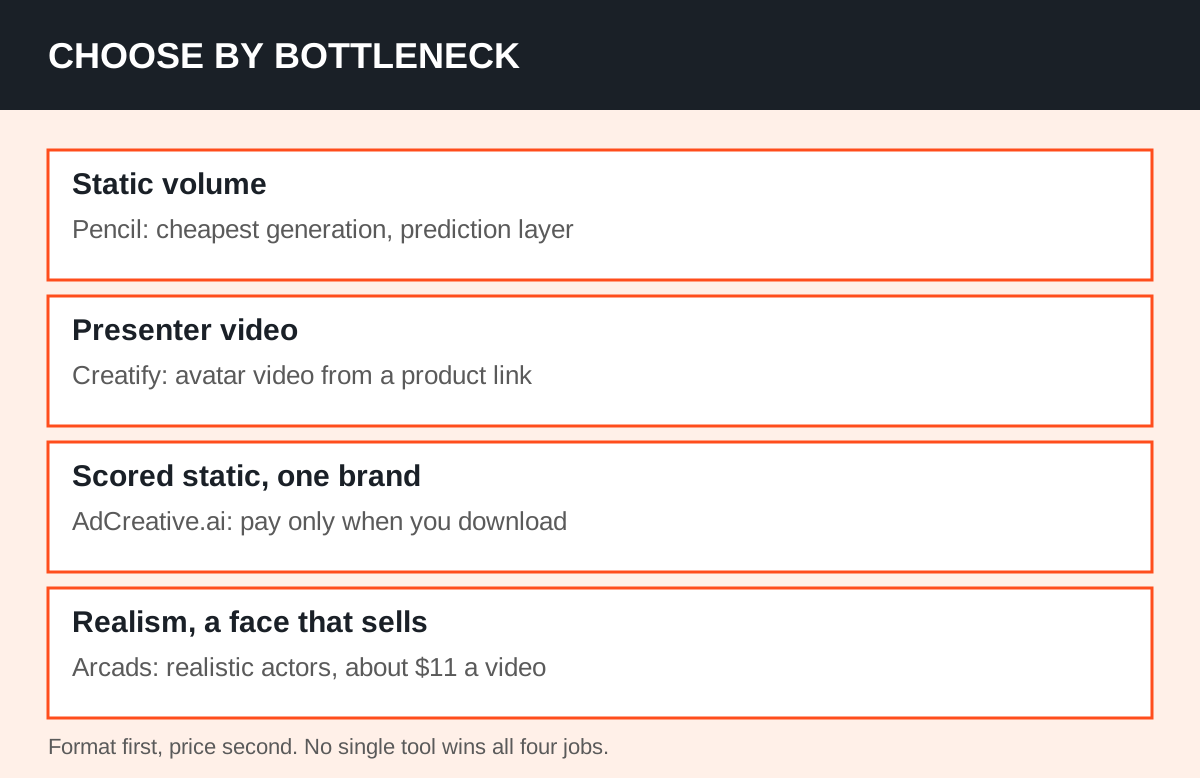
Pick by your bottleneck, not by the leaderboard. Each tool wins a different bottleneck.
If your bottleneck is static volume — many feed and display variants every week — start with Pencil Core at $14. It is the cheapest generation in this set, and its prediction layer helps a testing-heavy advertiser prioritise. Move to Growth at $55 when 50 generations stop covering your test plan.
If your bottleneck is presenter video for TikTok and Reels, start with Creatify's Standard plan. At the October 2026 read, a 15-second ad works out at about $1.36 on Standard and $0.98 on Pro by the published meter. Watch the revision rule: if your takes usually need two revision rounds, Pro's free same-script revisions change the maths in its favour.
If your bottleneck is scored static creative for one brand with a small team, AdCreative.ai Starter at $39 is the honest entry. The download-only meter suits advertisers who generate widely and publish narrowly. Skip it if your testing is video-led, since video needs the $249 Professional plan.
If your bottleneck is realism — an ad that must look like a real creator made it — Arcads is the specialist, at about $11 a video on its reported Starter price. That price only makes sense when the ad's job needs a face, and when you use close to the full billed minute.
And if you are still mapping the wider AI tool landscape before you commit, our AI Tools Explorer lists these tools alongside the rest of the marketing stack, so you can compare a creative tool against the automation and analytics tools it has to work with.
Whatever you pick, buy monthly first. Every tool here changed something material in 2026. A monthly plan lets you re-price the decision when the vendor re-prices the tool.
If you want help turning a winning creative into a full paid programme, our paid social and PPC service covers creative testing inside the wider campaign work, so the tool choice and the media budget are judged on the same results.
Frequently asked questions
What is the cheapest AI ad creative tool?
On cost per unit, Pencil is cheapest: Core at $14 a month for 50 generations works out at $0.28 per generation, and Growth at $55 for 250 works out at $0.22. But cheapest per generation is not cheapest per finished ad — Pencil charges for discarded generations, while AdCreative.ai charges only when you download.
How much does one AI video ad cost to make?
It depends on the meter. On Creatify's October 2026 Standard plan ($15 for 55 credits, 5 credits per 15 seconds), a 15-second ad costs about $1.36 and a 30-second ad about $2.73 before revisions. On Arcads, one talking-actor video costs about $11 on its reported $110 Starter plan, because billing rounds up to the full minute.
Are AI ad scores and predictions reliable?
They are prioritisation aids, not results. AdCreative.ai scores creatives before launch, and Pencil's prediction is trained on your own Meta account history — one comparison notes it needs at least fifty ads with ninety days of data per format and shows nothing below that. Judge every tool on cost per result in Ads Manager, not on its own score.
Can AI actors replace real creators for video ads?
For talking-to-camera ads, often yes; for product demonstration, not reliably. AI actors cannot consistently hold, unbox or demo a real item, so film product-in-use shots yourself and use the AI presenter for the talking sections. Never present an AI actor as a real customer testimonial.