
The guide
A seller lists a product at $30. It sells. The money that lands in their account is not $30, and it is not $30 minus a single fee either. TikTok Shop charges a referral fee on every order. Then the affiliate who sold it takes a cut you chose. Then someone pays for the shipping, the box, and the return if it comes back. This guide works through every fee a seller actually pays in 2026, with the numbers from TikTok's own Seller University pages, checked 12 November 2026. Prices are in US dollars unless a market says otherwise.
The US referral fee, the UK's higher commission, the affiliate cut you set yourself, fulfilment and refunds — worked through on a real $30 sale, with the numbers checked on TikTok's own pages on 12 November 2026.
Key takeaways
What does TikTok Shop actually charge?
TikTok Shop charges sellers one platform fee on every order: the referral fee. In the US it is 6% of most sales. There is no separate transaction fee, no monthly subscription and no listing fee — TikTok's own seller homepage says there are no setup fees.
That is the whole platform bill in the US. Everything else a seller pays is either a fee they choose, like affiliate commission, a cost of getting the product to the buyer, like fulfilment and shipping, or a cost of the sale going wrong, like refunds.
The distinction matters when you price a product. The referral fee is fixed and small. The optional costs are where the margin goes. This guide works through each one, then puts them together on a single $30 sale.
One warning before the numbers: fee pages change. TikTok updates its Seller University pages through the year — the US referral fee page was last updated in August 2025 and the UK commission page in September 2025. Every figure here was checked on 12 November 2026. If a number looks different in your Seller Center, trust the Seller Center.
The referral fee: the 6% that does most of the work
The referral fee is TikTok's cut of the sale, and it covers the platform, the payment processing and the traffic. It is charged on the customer payment plus any platform discount, minus tax — and the base includes the shipping the buyer pays.
The rate depends on the category. Most categories pay 6%. Five fine-jewellery sub-categories and all pre-owned items pay 5%. On collectibles and pre-owned items, the portion of a sale above $10,000 is charged at 3%.
| Category | Referral fee |
|---|---|
| Most categories | 6% |
| Fine jewellery (diamond, gold, jade, platinum, ruby/sapphire/emerald) | 5% |
| Pre-owned items | 5% |
| Collectibles and pre-owned, on the portion over $10,000 | 3% |
The 6% rate dates from 1 April 2024, when TikTok raised it across the board. Before that, sellers also paid a separate $0.30 transaction fee on each order.
That fee ended in April 2023, and the referral fee now covers payment processing too — the referral fee update page states the referral fee encompasses all TikTok Shop fees except shipping and tax.
A note on conflicting reports: some trade outlets reported a rise to 8% from August 2026, but TikTok's official category fee page still lists 6% for most categories, and that is the rate this guide uses. Check your own settlement reports before you act on a rumour.
Two small-print items. If a buyer gets a refund, TikTok returns the referral fee minus a refund administration fee of 20% of the referral fee, capped at $5 per SKU. And sellers registered in West Virginia or Texas have sales tax collected on the referral fee itself, a rule in force since 1 November 2025.
What a $30 sale actually leaves you
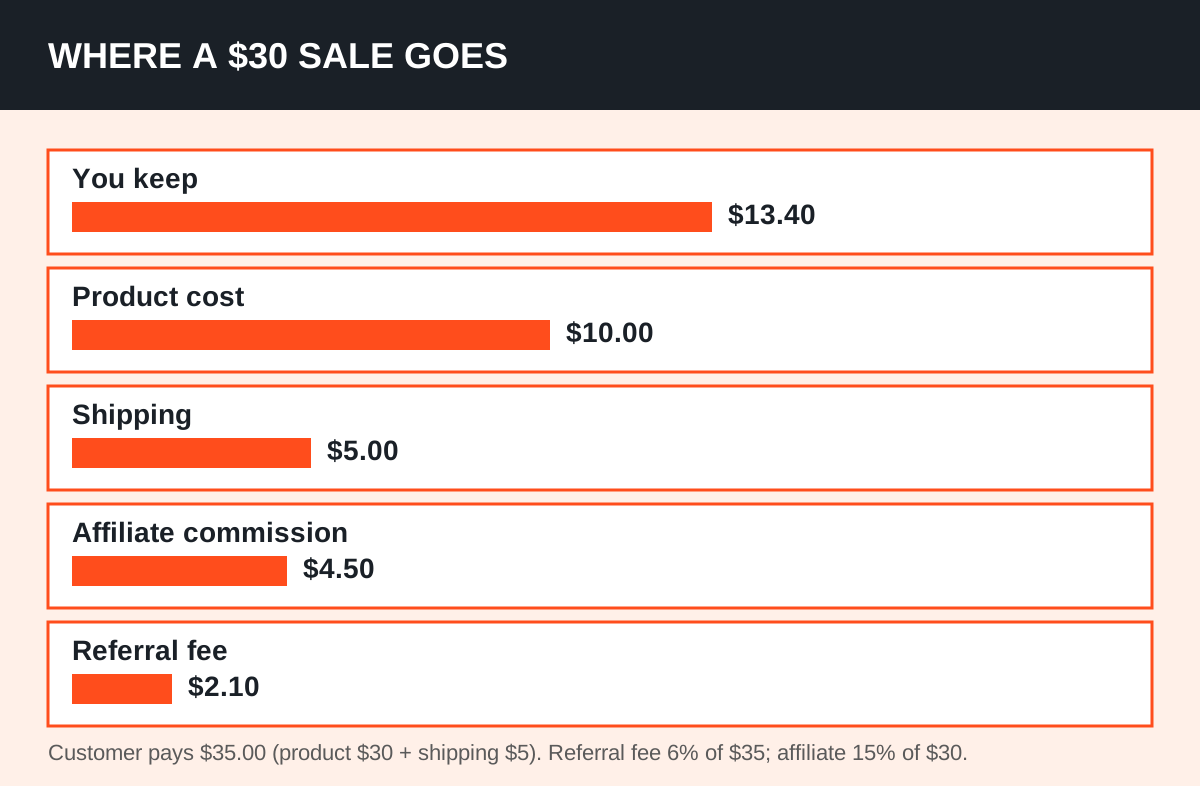
Percentages are abstract until they meet a real order. Take a $30 product. The buyer pays $5 shipping, so the customer payment is $35. You offer a 15% affiliate commission. The product costs you $10 and shipping costs you $5.
| Line | Amount |
|---|---|
| Customer pays (product + shipping) | $35.00 |
| Referral fee — 6% of $35 | −$2.10 |
| Affiliate commission — 15% of $30 | −$4.50 |
| Product cost | −$10.00 |
| Shipping cost | −$5.00 |
| You keep | $13.40 |
You keep $13.40 of the $35 the customer paid. The affiliate takes more than TikTok does — $4.50 against a $2.10 referral fee. That is the normal shape of a TikTok Shop sale: the platform fee is the smallest line.
Now change one decision: offer free shipping instead. The buyer pays $30, so the referral fee falls to $1.80 — but you still pay the $5 shipping. You keep $8.70, down from $13.40. Free shipping cost you $4.70 on this order, even though the fee went down. Price the shipping, not the fee.
The same discipline applies to ads. Our break-even ROAS guide teaches the same rule: a cost is only expensive relative to the margin it returns. Run the numbers on your own product before you set a commission or a shipping offer.
Affiliate commission: the fee you set yourself
Most TikTok Shop sales involve a creator, and the creator's cut is a commission you choose. In Target Collaboration you set it between 1% and 80% of the order's gross merchandise value, per product. Open Collaboration works the same way, with the rate you set applying to any creator who picks the product up.
The commission is calculated on revenue minus refunds, and creators are typically paid 15 days after delivery. That delay is worth knowing: the commission leaves your account after the sale, not with it.
Choose the rate against your margin, not against what other sellers offer. A 20% commission on a product with 30% margin leaves you 10% before the referral fee and shipping. One June 2026 benchmark put the average affiliate commission at around 13% — a useful starting point, not a rule.
Rates can move, but not freely. An increase applies immediately. A decrease is protected for creators already promoting the product: 30 days in Open Collaboration and five days in Target Collaboration. Shoppable Carousel videos earn 60% of the video rate. Dropping a rate to save money mid-campaign can cost you the creators doing the selling.
Work out how many creators you actually need before you set the rate. Our TikTok Shop Affiliate Calculator takes your monthly GMV goal, average order value, commission and invite quota and tells you the creator count.
Our TikTok Shop affiliate commissions guide explains the numbers behind the calculator in full.
Fulfilment: ship it yourself or let TikTok do it
After the platform fee and the creator's cut, the next cost is getting the product to the buyer. You have two routes: ship it yourself, or hand it to Fulfilled by TikTok, known as FBT.
Self-fulfilment means you buy the label, the box and the time. The shipping the buyer paid may cover the label, but the packing and the handling are yours. Keep that in the margin maths — the $5 shipping line in the worked example above was the seller's cost, not the buyer's payment.
FBT charges a per-unit fee that covers picking, packing, packaging and last-mile delivery. Storage is free for the first 60 days, with discounts of 14% to 43% for stock held up to 270 days. TikTok has cut the rate card several times through 2026, most recently for items between 70 and 150 lb from 1 November 2026.
The exact per-unit dollars sit in a rate-card table TikTok publishes as an image, so quote your own Seller Center figures rather than a guide's — they change often and they depend on weight and size.
What matters for the decision is the shape: FBT turns shipping into a fixed per-unit cost and gives the buyer free delivery, which lifts conversion.
Returns are the hidden line. Since 1 June 2026, FBT return handling is charged per unit instead of a flat $3 per order. Add the refund administration fee from section 02, and a returned order can cost you 20% of the referral fee plus the return handling before you count the product itself.
For a wider view of what a store costs to run, our Shopify marketing cost guide puts fulfilment in the context of a full store budget.
Selling in the UK or Europe? The bill is bigger
The US rate is the cheapest of the big markets. In the UK, TikTok charges a commission of 9% including VAT, on net sales plus customer-paid shipping plus platform discounts, minus refunds. Computers are charged at 5%.
Five European markets — Germany, Spain, France, Italy and Ireland — moved from 5% to 9% on 8 January 2026, according to trade-press reporting. Some electronics sit at 7% in those markets.
New sellers in Europe were reported to get a lower introductory rate for their first 60 days, but TikTok's own pages do not confirm that figure, so treat it as unconfirmed.
| Market | Commission | Notes |
|---|---|---|
| United States | 6% | No separate transaction fee |
| United Kingdom | 9% incl. VAT | Computers at 5% |
| Germany, Spain, France, Italy, Ireland | 9% from 8 Jan 2026 | Was 5%; some electronics at 7% |
The UK also has a small fee the US does not: trade press reports a £0.50 fee per delivered order for sellers who ship themselves, in force since July 2025. Orders fulfilled by TikTok or shipped via the platform are exempt.
It is a small number, but on a low-priced product it is the same size as the referral fee.
The practical point: do not copy a US price into a UK or European listing. The same $30 product earns roughly $0.90 less in the UK on commission alone, before the extra fee. Our TikTok Shop vs Amazon comparison sets TikTok's fees against Amazon's, market by market.
Five checks before you price a product
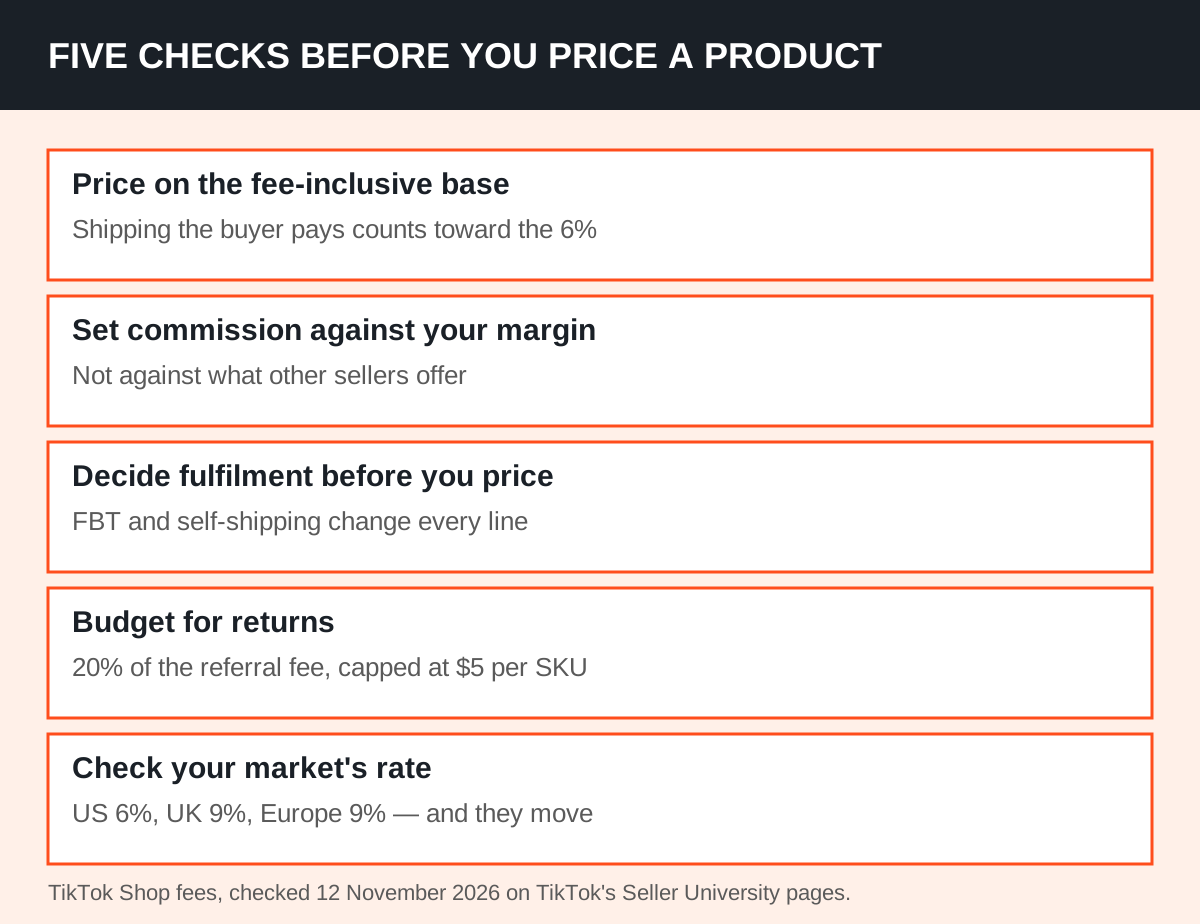
Fees are only useful if they change a decision. Run these five checks on every product before you list it.
Price on the fee-inclusive base. The referral fee is charged on the customer payment including shipping, so a product with paid shipping costs more in fees than the same product with free shipping — and free shipping still costs you the label.
Set the affiliate commission against your margin. Work out what is left after product cost, the referral fee and shipping, then choose the commission. The calculator linked above does the creator-count maths; the margin maths is yours.
Decide fulfilment before you price. FBT and self-shipping change the shipping line, the return line and the conversion rate. Pick the route, then set the price.
Budget for returns. A refund costs you 20% of the referral fee, capped at $5 per SKU, plus return handling — and the product may come back unsellable. A 10% return rate is a line in the budget, not a surprise.
Check your market's rate before you list. The US, UK and European rates are different, and they move. The rate on TikTok's Seller University fee pages — and in your own settlement reports — is the only one that counts.
Fees do not decide whether TikTok Shop is worth it. The margin after every fee decides that.
Work the example in section 03 with your own numbers, and if the answer is under 20%, change the price, the commission or the product — not the channel. Our TikTok Shop affiliate growth service page shows how we set up the whole program, from commission structure to creator outreach.
Frequently asked questions
How much does TikTok Shop take from each sale?
In the US, 6% of the customer payment (including shipping the buyer pays) for most categories — 5% for fine jewellery and pre-owned items, and 3% on the portion of collectibles and pre-owned sales over $10,000. There is no separate transaction fee and no monthly seller fee.
Is there a monthly fee to sell on TikTok Shop?
No. TikTok charges no setup fee, no monthly subscription and no listing fee. You pay the referral fee on orders, the affiliate commission you choose, and fulfilment and refund costs. That is the whole bill.
What affiliate commission should I offer on TikTok Shop?
You set it yourself, between 1% and 80% of the order value. Work it out from your margin: subtract product cost, the 6% referral fee and shipping, then choose a commission that leaves you a profit. One June 2026 benchmark put the average at around 13% — a starting point, not a rule.
What happens to fees when a buyer returns an order?
TikTok returns the referral fee minus a refund administration fee of 20% of the referral fee, capped at $5 per SKU. In the UK the full commission is refunded if the whole order is returned. You also pay return handling, and FBT return handling has been charged per unit since June 2026.