The guide
A customer asks ChatGPT for the best vitamin C serum for sensitive skin. The answer names three products, with sources beneath each one. Your product is not among them — and no ad slot can buy its way in. That answer is the new shop window. More than 1.2 billion people use ChatGPT each week, according to OpenAI's own announcements from October 2026. The question for a small business is not whether that matters, but what it costs to be the brand the answer names. This guide puts real numbers on it: the tracking tools from $29 a month, the agency ranges up to $50,000, and the work underneath that no tool can do for you.
The tool prices from $29 to $295 a month, the agency ranges from $1,500 to $50,000+, the work that actually earns a citation, and three realistic budgets for a small business — including the $0 start.
Key takeaways
Why "being recommended" is now a budget line
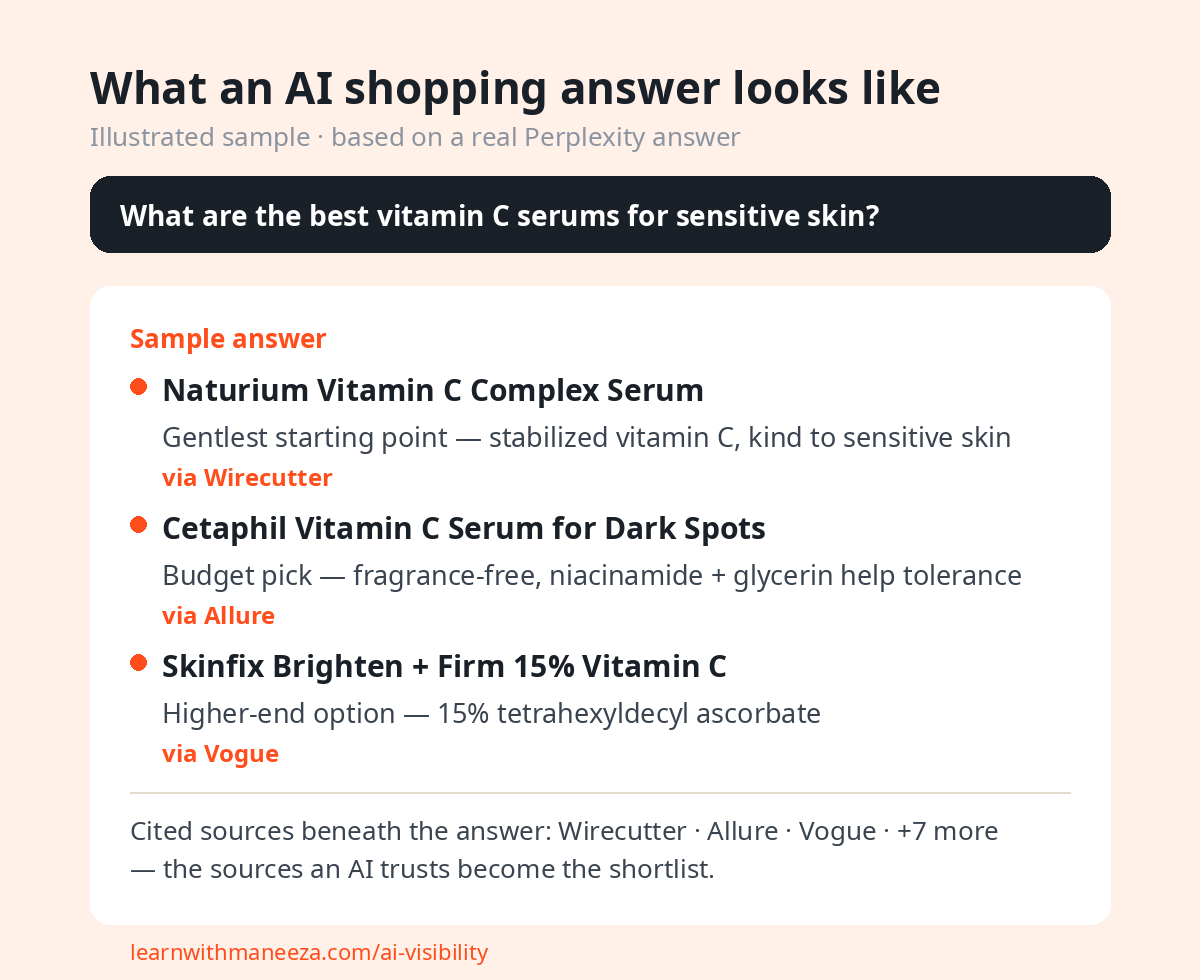
A customer used to type a question into Google and pick from ten blue links. Now they ask ChatGPT, and the answer picks for them. The shortlist in that answer is the new first page.
The scale is no longer debatable. OpenAI's own announcements put ChatGPT at more than 1.2 billion weekly users in October 2026, up from 800 million-plus in late 2025. That is roughly half again as many people in ten months.
The traffic is still small next to Google — but it is growing fast. SE Ranking's analysis of more than 101,000 websites puts AI referral traffic at roughly 0.32% of all website traffic in 2026, against 42.75% for organic search.
Previsible's 2026 State of AI Discovery Report tracked 6.77 million AI-driven sessions across 166 websites. It found monthly AI-referred sessions grew roughly tenfold over nineteen months, reaching about 644,000 by May 2026.
ChatGPT dominates that traffic. It carries 92.4% of referrals from standalone AI platforms in the Previsible study, and 74.78% of all AI referrals in SE Ranking's larger dataset. For ecommerce the growth is sharper still: AI referral traffic to online stores rose 37-fold over the study period.
Here is the part most budgets miss: the click is not the prize. Comscore's research found outbound clicks in only 5.2% of ChatGPT conversation sessions. Most people read the answer and act on it without ever visiting a source.
That is why the recommendation itself is the asset. Being named in the answer shapes the purchase even when no click follows.
OpenAI has also started selling ads inside ChatGPT. That makes the unpaid recommendation more valuable, not less — the free shortlist is the one readers trust. Our guide to ChatGPT ads and what advertisers should prepare covers the paid side of the same shift.
What the tracking tools actually cost
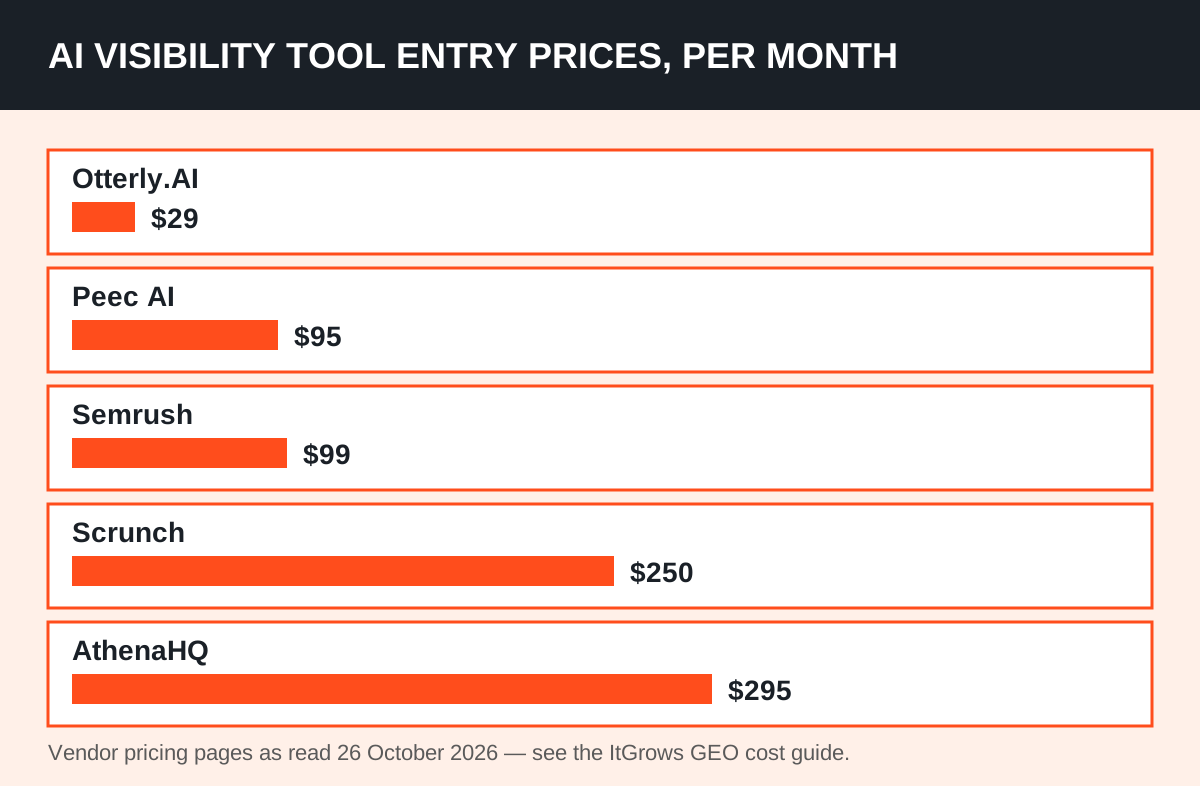
The first thing most businesses buy is a tracker: software that asks the AI assistants your buyers' questions and reports whether your brand gets named. The entry prices, read from the vendors' own pricing pages on 26 October 2026, are lower than most people expect.
| Tool | Entry price per month | What the entry plan covers |
|---|---|---|
| Rankscale | $17 (yearly billing only) | Cheapest entry in the category |
| Otterly.AI | $29 | 15 tracked prompts |
| Peec AI | $95 | 50 tracked prompts, pick 3 AI models |
| Semrush AI Visibility Toolkit | $99 per domain (billed annually) | Adds to the Semrush SEO suite |
| Scrunch | $250 (billed annually; $300 month to month) | 350 custom prompts, 4 engines |
| AthenaHQ | $295 | Free plan exists; Starter adds a content agent |
| Ahrefs Brand Radar | From $199 | Brand tracking inside the Ahrefs suite |
| Profound | Free 7-day trial, then custom pricing | Enterprise plans; no self-serve price published |
Those figures come from ItGrows' GEO cost guide, which read each vendor's pricing page on 26 October 2026. Prices change often, so treat this table as a November 2026 snapshot and check the vendor's page before you buy.
The sticker price is not the comparison that matters. Ask how many buyer questions a plan covers, how many assistants it asks, and how many times it asks each question. Ask the same question three times and an assistant often names different businesses.
Two traps sit inside the cheap tier. First, the prompt count: 15 prompts covers one product line, not a whole catalogue. Second, the engine count: ChatGPT alone is not the whole market — Gemini, Claude and Perplexity split the rest, and Google's AI Overviews sit on top of all of it.
Our own starting point costs nothing: the free AI Visibility Snapshot checks whether ChatGPT, Perplexity and Gemini name your business at all, and it lands within 48 hours. Run that before paying for any tracker — it tells you whether the problem is real.
What the tools don't buy you
A tracker tells you whether assistants name you. It does not make them name you. The work underneath is where the money actually goes, and it comes in three parts.
First, pages that answer buyer questions, published on your own domain. Assistants cite pages, so pages are what you are paying for.
The pages that win answer the prompt directly: comparison content, "best for X" guides, pricing explainers, honest limitation sections. Our guide to checking if ChatGPT can see your business walks through the exact checks.
Second, crawler access and entity consistency. The assistants' crawlers — GPTBot, ClaudeBot, PerplexityBot — must be able to read your site.
Your business must also look like the same business everywhere it appears: the same name, the same description, the same facts. Only 36 brands out of more than 1,200 appear on every AI search platform every month, according to Semrush's AI Visibility Index. Consistency is the gate.
Third, earned mentions. Muck Rack's Generative Pulse study of more than 25 million cited links found that 84% of the links AI assistants cite come from earned sources, and 27% from journalism.
You cannot buy that share with a subscription. It comes from being quoted, reviewed, listed and linked by other people — the slow work of PR, partnerships and genuinely useful content.
One more cost hides here: volume. A site with complete technical markup but only 75 pages can still be absent from answers on its own topic. A site with a large crawlable library gets visited constantly.
Two articles a month cost less than twenty — and give assistants less to quote. If you are choosing between a $95 tracker and four answer pages, buy the pages first. Our content and organic service exists for exactly this: the pages, published on your domain, that assistants can cite.
What agencies charge, and when that makes sense
If you want someone else to do the work, the ranges are wide — and worth reading as price lists, not averages.
WebFX's cost guide, published 15 October 2026, puts agency retainers at $1,500 to $5,000 a month for small businesses, $5,000 to $25,000+ for mid-sized companies, and $25,000 to $50,000+ for enterprises. Projects run $5,000 to $50,000, and hourly rates $50 to $300.
For scale, Clutch's average monthly SEO cost is $3,199.19, reported by MV3 Marketing in August 2026. AI visibility work sits in the same labour market, so expect similar hourly rates.
There is a middle tier between a tracker and a full agency. Done-for-you GEO plans publish the pages, fix crawler access and measure every two weeks.
They start around $299 a month. ItGrows publishes exactly that price, plus a one-time $299 setup that is free when three months are paid upfront. That is below the agency floor, because the scope is narrower: pages and measurement, not strategy decks and PR.
The decision rule is simple: size the fee against what one customer is worth. If a single new client covers a year of fees, done-for-you help is easy to justify. If not, keep it lean until the measurement shows movement.
Before signing anything, ask every provider the same five questions.
How many pages per month, and on whose domain? Who fixes crawler access, and when? Which assistants are measured, how many times per question, on a fixed question set? How much of the fee is hours, and how much is published work? Can you leave month to month — and keep the content?
Be careful with one promise in particular. No provider can promise a particular answer, or the week it first appears. A serious one promises the trend: in 90 days, assistants name you more often than on launch day. Anything stronger than that is a sales line, not a plan.
Three budgets for a small business
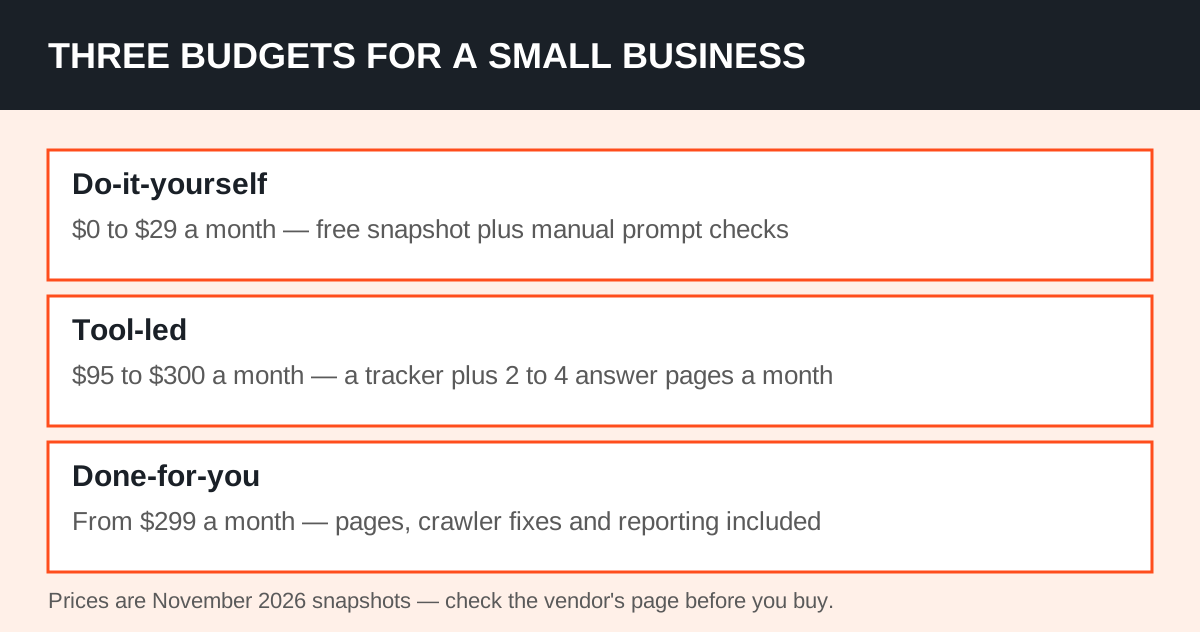
Put it together and a small business has three honest options. Pick by how much time your team has, not by how ambitious the pitch sounds.
The do-it-yourself route costs $0 to about $29 a month. Start with the free snapshot, then run ten buyer questions through ChatGPT, Gemini and Perplexity yourself, three times each. Write down who gets named.
Add Otterly.AI at $29 a month when the manual checks get tedious. This fits a business with more time than money — and it works, because the measurement is honest even when it is manual.
The tool-led route costs roughly $95 to $300 a month. A Peec AI or Semrush plan at around $99, plus two to four answer pages a month written in-house.
The tool tells you which questions to write for, and the pages are the work. Budget a few hours a week of someone's time on top of the subscription — the tool does not write the pages.
The done-for-you route starts around $299 a month and runs past $1,500. The provider publishes the pages, fixes crawler access and reports every two weeks. This fits a business whose team has no hours to spare and whose average customer is worth enough to cover the fee in one or two sales.
Whichever route you pick, keep one line separate in the budget: the content. Most small businesses should spend at least twice as much on pages as on measurement in the first six months.
Our AI tools explorer lists the visibility tools we track with plain-English verdicts, if you want to compare the tracker tier before committing.
How do you tell whether the money is working?
AI visibility is measured in mentions, not in clicks. The clicks are too few to steer by: remember, only about 5% of ChatGPT sessions produce an outbound click at all. Three numbers tell you whether the spend is working.
First, your mention rate on a fixed set of buyer questions. Pick ten to twenty questions your buyers actually ask, run each one three times across ChatGPT, Gemini and Perplexity, and count how often your brand is named. Same questions, same number of asks, every two weeks. The first comparable reading arrives after 30 days; the second confirms the pattern.
Second, your citation share against competitors. It is not enough to be named — the question is whether you are named more often than the three businesses your buyers compare you with. A tracker reports this directly; manually, it is the same count with competitor names added.
Third, AI referral sessions in your analytics. In Google Analytics 4, AI referrals arrive under their own referrers: chatgpt.com, perplexity.ai, claude.ai, copilot.microsoft.com.
Google's AI Overviews and AI Mode traffic arrives under Google's referrer and cannot be split out. Expect small numbers.
The value is in the trend and in the quality: AI-referred visitors stay longer than average. Brands cited inside an AI Overview earn about 35% more organic clicks and 91% more paid clicks than competitors left out of it, according to Seer Interactive's analysis.
What not to measure: your overall organic traffic in the first 90 days. AI visibility moves the mention rate weeks before it moves traffic, and a business that judges the spend on traffic alone will cancel it the week before it pays off. Judge the first quarter on mentions. Judge the second on referrals and leads.
How do you start this week for free?
You do not need a budget to find out whether you have a problem. One afternoon, four steps, and you know where you stand.
Step one: take the free snapshot. Our AI Visibility Snapshot checks whether ChatGPT, Perplexity and Gemini name your business, checks whether your site blocks their crawlers, and names your two or three biggest gaps in plain language. It lands within 48 hours, free.
Step two: write down ten questions your buyers ask before they buy — "best X for Y", "how much does X cost", "X vs Y". Run each one through ChatGPT yourself, once, and note who gets named. That is your baseline, and it took twenty minutes.
Step three: fix the cheapest gap first. If a crawler is blocked, unblock it. If your best pages bury the answer under 500 words of introduction, move the answer to the top. If you have no page for your most-asked buyer question, write it — one page, one question, one direct answer.
Step four: pick your budget from section 05 and put the ten questions on a two-week repeat. Re-run them, count the mentions, and watch the trend. If the number moves, keep spending. If it does not move after 90 days, the problem is the pages, not the tracker — spend the money there instead.
And if the snapshot comes back saying you are invisible, do not panic. Most small businesses are. The fix is ordinary work — answer pages, crawler access, earned mentions — priced above, in that order.
Start free, measure honestly, and let the mentions decide the budget. If you would rather hand the whole job over, our content and organic team does the pages and the measurement together. Take the free snapshot first, either way, so you know what you are paying to fix.
Frequently asked questions
How much does AI visibility cost per month?
A tracking tool costs $29 to $295 a month at entry level (vendor pricing pages, October 2026), and done-for-you plans start around $299 a month. Agency retainers run $1,500 to $50,000+ a month depending on business size (WebFX, October 2026). A small business can start at $0 with a free snapshot and manual prompt checks.
What is the cheapest AI visibility tool?
At entry level, Rankscale starts at $17 a month on yearly billing and Otterly.AI at $29 a month for 15 tracked prompts (vendor pricing pages, 26 October 2026). Cheap plans cover few prompts and few AI engines, so check how many buyer questions and assistants the price actually includes before comparing.
Can you get ChatGPT to recommend your business for free?
Yes — the recommendation itself cannot be bought. ChatGPT cites pages that directly answer buyer questions, so a business can earn mentions by publishing direct-answer pages on its own domain, keeping AI crawlers unblocked, and earning mentions from other sites. What costs money is the measurement and the labour, not the mention.
How long does it take for AI visibility work to show results?
No provider can promise a particular answer or a date. Measure your mention rate on a fixed set of buyer questions every two weeks; the first comparable reading arrives after about 30 days, and a serious provider works to a 90-day trend — assistants naming you more often than on launch day. Traffic and leads follow mentions, usually in the second quarter.