
The guide
Klaviyo's headline price is $20 a month, and it is real. It is also the price for a list of 500 profiles, which most working stores outgrow fast. The question that matters is not the starting price. It is what the same account costs at 5,000, 10,000 and 50,000 profiles. The answer surprises store owners for one reason. Klaviyo bills on active profiles, not on emails sent. Every contact who can still receive your marketing counts toward your tier, whether you emailed them this month or not. That single rule explains most unexpected Klaviyo bills. A store that imports years of checkout records, runs a giveaway, or simply grows will see its tier rise even if its sending habits never change. This guide gives you the price ladder, the definitions behind it, and the honest ways to hold the bill down. Prices are US dollars on monthly billing, checked against Klaviyo's pricing page and help pages in November 2026. Use the calculator for your exact tier before you commit, because Klaviyo adjusts its tiers over time.
Klaviyo pricing by list size, in plain numbers: the free plan, the email ladder from $20 to $2,300, what SMS adds on top, and the suppression lever that lowers the bill without deleting your data.
Key takeaways
Why does Klaviyo bill on profiles, not on emails sent?
Before February 2025, Klaviyo billed mainly on the profiles you actually emailed. That changed. Since the February 2025 billing change, your tier follows your total active profile count, even if you only email part of the list.
An active profile is any profile that can receive email marketing from you. That includes subscribers who opted in, and it also includes customers added through a store integration who shared an email at checkout but never subscribed to marketing.
That second group is where stores get caught out. A Shopify sync can pull years of checkout records into Klaviyo in one go. Those records are emailable profiles in Klaviyo's counting, even if you never planned to mail them.
What does not count is just as important. Klaviyo's help page on suppressed profiles states plainly that suppressed email profiles do not count toward the email plan's active profile limit. Unsubscribed profiles do not count either.
So the bill is really a count of your reachable list. If that list is full of people you will never email again, you are paying rent on an audience you do not use.
What does Klaviyo cost at each list size?
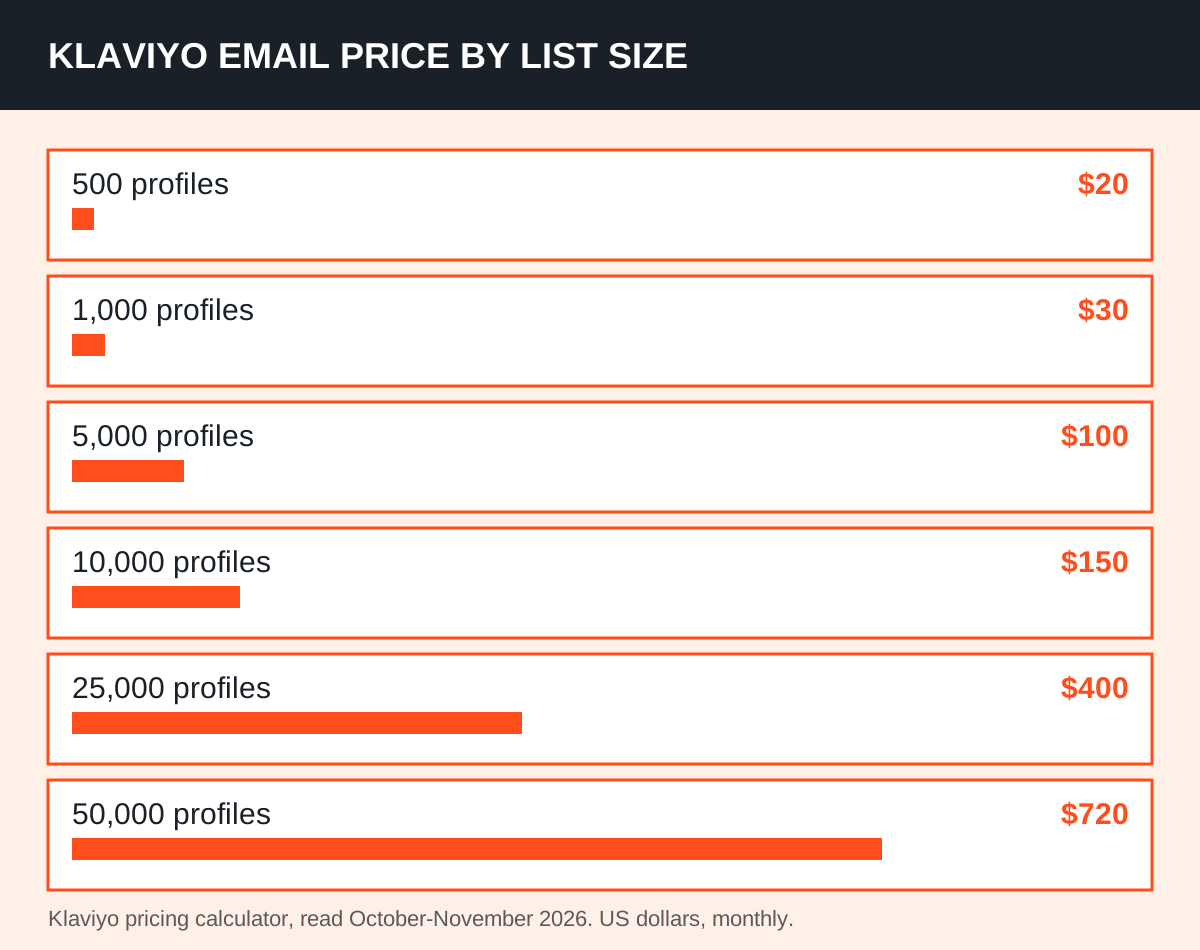
Start with the table. It shows the email plan at the list sizes stores actually ask about, plus the entry Email + SMS bundle at the same sizes. Email sends scale at roughly ten times the profile count, so sends are rarely the constraint.
| Active profiles | Email plan / month | Email + SMS / month | Email sends / month |
|---|---|---|---|
| Up to 250 | Free | Free within limits | 500 |
| 500 | $20 | $35 | 5,000 |
| 1,000 | $30 | $45 | 10,000 |
| 5,000 | $100 | $115 | 50,000 |
| 10,000 | $150 | $165 | 100,000 |
| 25,000 | $400 | $415 | 250,000 |
| 50,000 | $720 | $735 | 500,000 |
Read the ladder as steps, not as a smooth slope. The jumps between steps are uneven. Going from 5,000 to 10,000 profiles adds $50 a month. Going from 10,000 to 25,000 adds $250 a month.
Above 250,000 profiles, Klaviyo moves to custom pricing, and the email ladder tops out at $2,300 a month at 250,000 profiles. At that scale the conversation is a sales call, not a slider.
Two warnings apply to every row. First, these are list prices from Klaviyo's pricing page as read in October and November 2026, and first-month promotions can make month one look cheaper than month two. Second, your exact tier price comes from the calculator for your profile count, because Klaviyo's slider has smaller steps between the headline sizes in this table.
What do you actually get at every tier?
Here is the part most pricing guides bury. The paid email feature set does not change as you climb the ladder. A $20 account and a $720 account get the same core email platform: flows, segments, reporting, web forms and integrations.
That sameness is a feature, not a trap. A small store gets predictive analytics, AI-generated segments and content help, and the same flow builder as a large one. You are paying for list size, not for unlocking features.
The free plan is the exception. It covers up to 250 active profiles and 500 emails a month, with a small mobile messaging allowance and email support for the first 60 days only. It is a genuine trial tier, not a plan for a trading store.
It also stops sending when you pass its limits, rather than upgrading you automatically. That is worth knowing before launch week. A free account that crosses 250 profiles mid-campaign will simply stop until you upgrade or fall back under the limit.
Paid tiers behave differently. If your active profile count passes your tier, Klaviyo moves you to a higher tier at your next billing cycle. Auto-upgrade for profiles cannot be switched off, which is why the suppression habit in section 06 matters more than any discount hunt.
What does SMS add to the bill?
SMS is not included in the email price. It sits alongside it as a separate mobile messaging plan, priced by message volume and destination country, not by profile count.
The entry point most stores meet is $15 a month for a starter mobile allowance, historically 1,250 credits. That is why the Email + SMS bundle starts at $35 a month at 500 profiles: $20 of email plus $15 of mobile messaging.
At larger sizes the same $15 gap holds at the entry mobile allowance, so Email + SMS reads $115 at 5,000 profiles and $165 at 10,000. But that gap only holds while your texting stays inside the starter allowance.
Send more, and the mobile plan steps up on its own. Klaviyo has also been moving accounts from a credit model toward per-message dollar pricing, with carrier fees built into the rate. A US text and a picture message do not cost the same, and a text to another country costs more again.
The practical rule is simple. Budget SMS as its own line, estimate it from your actual flow volume, and check the mobile calculator for your countries before you add SMS to a welcome series or an abandoned-cart flow.
How does the bill grow as your list grows?
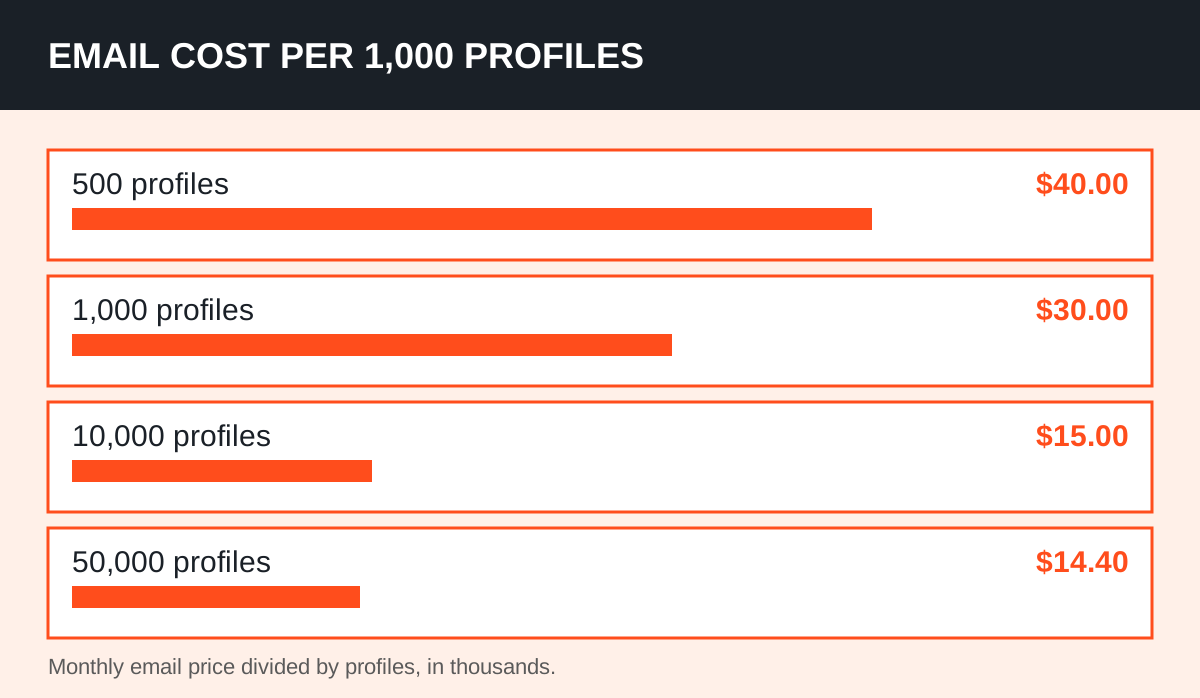
Take a store that starts at 1,000 profiles and grows steadily. At 1,000 profiles it pays $30 a month for email, or $360 a year. At 5,000 it pays $100 a month, or $1,200 a year. At 10,000 it pays $150 a month, or $1,800 a year.
At 50,000 it pays $720 a month, or $8,640 a year. That is 24 times the starting monthly bill for 50 times the list. The unit cost falls as you grow, which is the one piece of good news in the ladder.
Cost per 1,000 profiles drops from $40 at 500 profiles to $15 at 10,000, then to $14.40 at 50,000. Growth still raises the total bill every time you cross a tier, but each new thousand profiles gets cheaper than the last.
That is why list growth deserves a budget line of its own. Our guide to how much Shopify marketing costs treats email as one slice of a store's marketing budget, not as a fixed cost.
When email is 10% of revenue work, a tier jump is a rounding error. When it is a cost with no flow revenue behind it, the same jump stings.
Judge the bill against what your flows earn, not against the starting price. Our break-even ROAS guide shows the same discipline for paid ads: a cost is only expensive relative to the margin it returns.
How do you keep the bill down without hurting revenue?
Suppression is the lever. It removes a profile from the billable count while keeping its history in your account, so you lose nothing you might need later.
Start with the never-engaged. Build a segment of profiles that have never opened, clicked or bought over a long window, and who are not recent subscribers. Suppress them in bulk, then check your active count in Audience before you touch Billing.
Then protect the list you keep. A sunset flow that asks quiet subscribers whether they still want your emails will either re-engage them or confirm they should go. Either outcome helps, because an engaged list converts better and costs less per sale.
Do not delete profiles to save money. Deletion wipes the history that suppression keeps, including the record that someone unsubscribed or marked you as spam. Suppressed profiles stay out of sends automatically, which is exactly what you want.
Finally, finish the job in Billing. A lower profile count does not always lower the bill on its own, so once the count has updated, select the lower tier yourself or confirm auto-downgrade is on. Check the count again after a few days, because bulk changes take time to refresh.
Is Klaviyo worth it at your size?
Use three tests, in order. First, are you inside the free plan's limits, with a list under 250 and sends under 500 a month? If so, stay free and learn the flow builder before you pay anything.
Second, do your flows earn their keep? A welcome series, an abandoned-cart flow and a post-purchase flow should return multiples of the monthly tier. If they do, a tier jump is growth, not waste. If they do not, fix the flows before you grow the list.
Third, is your billable count honest? If a large share of your profiles are checkout records you never email, suppress them and re-price the account. Many stores find their true list is a tier or two smaller than their billed list.
If all three tests pass and the bill still feels high, the question is no longer about Klaviyo's price. It is about whether your email program earns its place in the budget at all. That is a strategy question, and our email and lifecycle service page shows how flows, campaigns and list health fit together as one program.
For stores comparing platforms before they commit, our best CRM software for small businesses guide covers how customer data should flow between your store, your email tool and your CRM, so the tool you pick does not become another silo.
Frequently asked questions
What is an active profile in Klaviyo?
An active profile is any profile that can receive email marketing from you, including subscribers and customers added through a store integration who shared an email at checkout. Suppressed and unsubscribed profiles do not count toward the email plan's active profile limit.
How much does Klaviyo cost for 10,000 contacts?
At 10,000 active profiles the email plan is $150 a month, including about 100,000 email sends. The entry Email + SMS bundle at the same size is $165 a month, before any extra mobile messaging volume beyond the starter allowance.
Does Klaviyo charge for unsubscribed or suppressed contacts?
No. Klaviyo's help documentation states that suppressed email profiles do not count toward the email plan's active profile limit, and unsubscribed profiles are likewise excluded. Suppressing profiles you no longer email is the main way to bring a billable count down.
Is there an annual discount for Klaviyo?
No annual discount is shown for Klaviyo's self-serve plans: they bill monthly, and the yearly totals in this article are simply twelve monthly bills. Enterprise or custom arrangements above the self-serve ladder are priced separately.