The guide
Email is still the highest-return channel a store owns. Litmus's State of Email 2026 puts the average return at $36 to $42 for every $1 spent, and ecommerce does better than average at $45. But the return depends on the tool. A generic newsletter app sends campaigns. An ecommerce email platform knows what each customer bought, what they browsed, and what they left in the cart — and it acts on that data without you writing a new email each time. This guide compares the five platforms stores actually choose between — Klaviyo, Omnisend, Mailchimp, Brevo and Shopify Email — prices each at real list sizes, then shows which store each one fits.
What makes email software "for ecommerce", what Klaviyo, Omnisend, Mailchimp, Brevo and Shopify Email cost at 500, 5,000 and 10,000 contacts, which flows earn the revenue, what to check before you switch, and the one-afternoon method for picking.
Key takeaways
What makes email software "for ecommerce" different?
A generic email tool stores addresses and sends campaigns. An ecommerce platform connects to your store and watches behaviour. That connection is the whole difference.
When a customer buys, browses, or abandons a cart, the store event flows into the platform — which then sends the right email at the right moment, to that one customer, without anyone scheduling it.
Three capabilities mark a real ecommerce tool. First, pre-built flows: welcome, abandoned cart, post-purchase and win-back sequences that run on store events. Second, segments from purchase data: buyers of a category, repeat customers, high spenders, people who have not bought in 90 days.
Third, revenue reporting per email: you see what each campaign and flow earned, not just opens and clicks. That is the number that decides whether the tool pays for itself.
Open rates are a weak signal now — Apple Mail Privacy Protection inflates them — so judge a platform on revenue per recipient instead. Any tool here reports that figure; a tool that only reports opens is not an ecommerce tool.
The return is real when the setup is real. Litmus's State of Email 2026 puts the average return at $36 to $42 per $1 spent, with ecommerce at $45. That average belongs to stores with flows running, not one newsletter a month.
What does each platform cost at your list size?
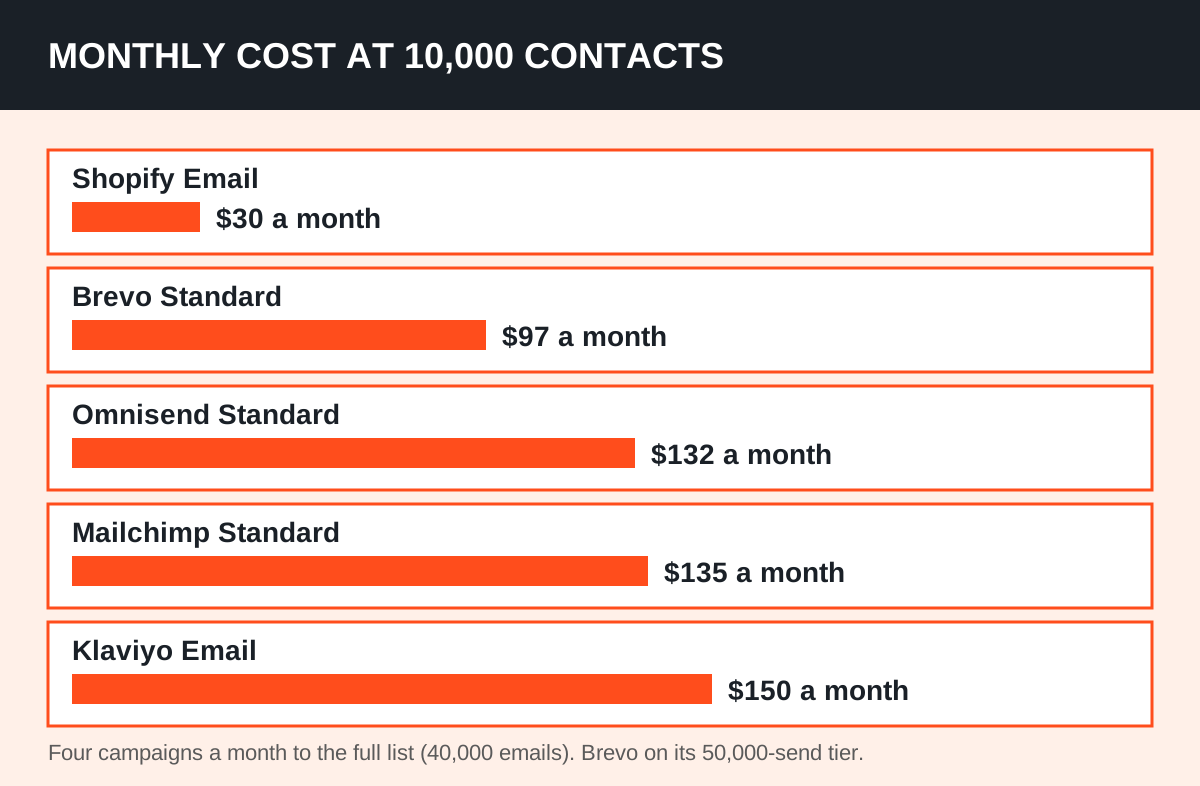
Price comparisons fail when they compare entry prices. A $16 plan and a $20 plan are the same purchase at 500 contacts and a different one at 10,000. Here is the honest version: the same store, at three list sizes, on monthly billing.
| Platform | Free plan | Entry paid | At 10,000 contacts, 4 sends a month | Bills by |
|---|---|---|---|---|
| Klaviyo Email | 250 profiles, 500 sends | $20 a month at 500 profiles | $150 a month | Active profiles |
| Omnisend Standard | 250 contacts, 500 emails | $16 a month at 500 contacts | $132 a month | Contacts |
| Mailchimp Standard | 250 contacts, 500 sends | $20 a month at 500 contacts | $135 a month | Contacts, including unsubscribed |
| Brevo Standard | 300 emails a day | $18 a month at 5,000 sends | $97 a month | Emails sent |
| Shopify Email | 10,000 emails a month | No subscription | $30 a month | Emails sent |
The figures assume four campaigns a month to the full list — 40,000 emails at 10,000 contacts. Brevo's figure is its 50,000-send tier, the tier that covers 40,000 sends. Shopify Email's is 10,000 free emails, then $1 per 1,000 for the other 30,000.
Klaviyo's curve is the steepest: $20 a month at 500 profiles, $30 at 1,000, $100 at 5,000 and $150 at 10,000, with about ten sends per profile included. Klaviyo and Omnisend's prices, checked October 25, 2026 confirm the gap: Omnisend Standard is cheaper than Klaviyo Email at every list size we checked.
Mailchimp looks cheap at entry and catches up fast. Mailchimp's pricing, checked October 2026, puts Standard at $20 a month for 500 contacts, $60 at 2,500, $100 at 5,000 and $135 at 10,000. Its free plan was cut in February 2026 to 250 contacts and 500 sends.
Watch the billing trap. Mailchimp charges for unsubscribed contacts too — only archived or deleted contacts escape the count. Klaviyo bills on active profiles: any contact that can receive marketing, whether you emailed them or not. A list you never mail still costs money on both.
Brevo flips the model. Brevo's pricing, checked November 4, 2026, charges by emails sent, not contacts stored. Starter is $9 a month for 5,000 emails but has no automation. Standard is $18 a month and adds automation, A/B testing and removes the Brevo logo. A big list you rarely mail is cheap on Brevo and expensive on Klaviyo.
Shopify Email — renamed Shopify Messaging in December 2025 when SMS was added — is the cheapest by a distance. Shopify's published email pricing, from the Shopify Help Center gives every paid Shopify plan 10,000 free emails a month, then $1 per 1,000 up to 300,000. Abandoned checkout emails are always free.
All five prices are a November 2026 snapshot — check the live page before you commit. The pattern matters more than any single figure: contact-billed tools punish quiet lists, send-billed tools punish frequent senders.
Which platform fits which store?
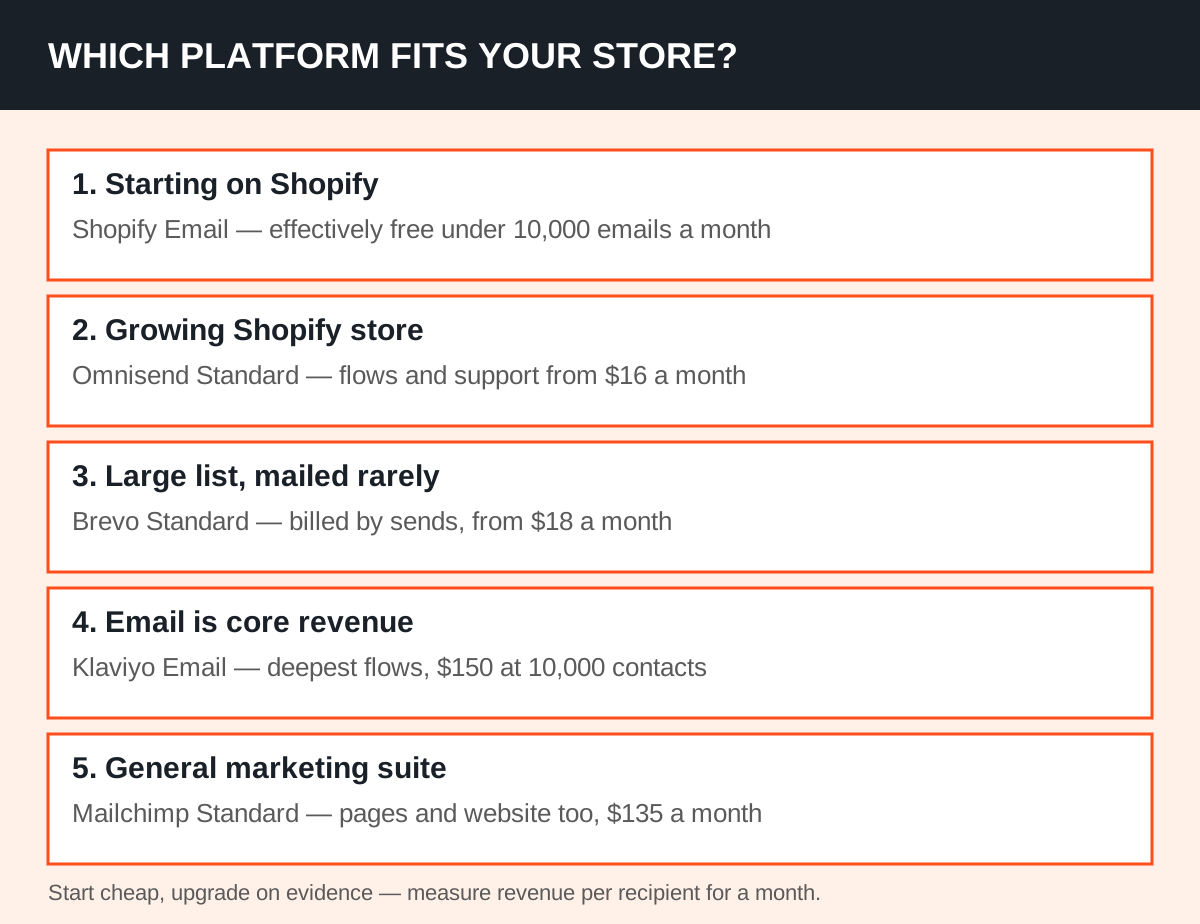
Price is only half the choice. The other half is what your store needs the tool to do — match the platform to your stage, not to the brand everyone else uses.
A store just starting on Shopify, sending a weekly newsletter and cart emails, should stay on Shopify Email. It costs close to nothing, lives inside the admin you already use, and covers the basic automations. Move on when you need segments built from purchase history.
A growing Shopify store that wants proper flows without Klaviyo's bill should look at Omnisend first. Standard starts at $16 a month with the full automation builder and pre-built cart and welcome flows. Every plan — including free — gets 24/7 live chat support. Pro, from $59 a month, adds unlimited sends and SMS credits equal to your plan cost.
One Omnisend catch: for accounts created on or after May 4, 2026, SMS is restricted to the Pro plan — Free and Standard accounts cannot send SMS campaigns at all.
A store that sends rarely to a large list should look at Brevo. A 20,000-person list mailed twice a month costs far less than on any contact-billed tool, because Brevo bills by sends. The trade-off is depth: its automation is thinner than Klaviyo's, and Professional jumps to $499 a month.
A store where email already drives a serious share of revenue should pay for Klaviyo: the deepest Shopify integration, the strongest segmentation and predictive analytics, and the most mature flow library. Our Klaviyo pricing guide breaks down where its bill climbs and how to keep it down.
Mailchimp fits a store that also needs landing pages, a basic website, or a general marketing tool rather than a pure ecommerce one. Its automation is capable, but it is not built around store events the way Klaviyo and Omnisend are — and its billing, including unsubscribed contacts, is the least forgiving of the five.
HubSpot is the sixth option worth one line: it fits when email is one piece of a CRM-led operation, not the main revenue channel. Marketing Hub Starter is $20 per seat a month with 1,000 marketing contacts, but Professional jumps to $890 a month plus a $3,000 onboarding fee. For a store, that cliff arrives fast.
What do the flows earn that campaigns don't?
Campaigns are what you send. Flows are what the store sends for you — and the difference shows up in revenue per email.
In our client work, three flows do most of the earning. The welcome flow turns a new subscriber into a first buyer with a short sequence, not a single discount email.
The abandoned cart flow recovers baskets over three emails: a reminder, an objection answer, then an incentive only if the first two fail. The post-purchase flow asks for a review, suggests a complementary product, and brings the buyer back.
A fourth flow earns quietly: win-back. Customers who have not bought in 90 days get a different message from recent buyers — a reason to return, not another product announcement. Segmenting by recency is the simplest high-value segment a store can build.
Measure flows on revenue per recipient, not open rate. A welcome flow to 100 new subscribers that earns $80 has done more than a campaign to 10,000 people that earns $200. The campaign looks bigger; the flow earns more per person.
Set the flows up before you worry about campaign design. A store with four working flows and plain campaigns beats a store with beautiful campaigns and no flows, every time we have measured it. Design is polish; flows are the engine.
The same logic applies to the rest of the budget. Our guide to how much Shopify marketing costs shows how email sits inside the full monthly spend — and why a tool that earns its fee from flows is cheaper than a free tool that earns nothing.
What should you check before you switch?
Switching email tools is a migration, not a signup. Get the order wrong and you lose your list's trust in a week.
First, clean the list. Export subscribers, suppress the unengaged, and do not import people who never consented. A clean list protects your sender reputation, and on contact-billed tools it cuts the bill on day one.
Second, authenticate your domain before you send anything. SPF, DKIM and DMARC tell inbox providers the mail is really from you. Our free DMARC checker confirms whether your domain passes — fix a failed check before you migrate.
Third, warm up the new sender. Start with your most engaged subscribers, then widen the audience over two to three weeks. A new platform blasting a full cold list at once is how deliverability dies.
Fourth, rebuild the flows before the campaigns. Migrate the welcome, cart and post-purchase sequences first, test them with real orders, then move the newsletter. A week without a cart flow costs more than a week without a campaign.
Fifth, keep the old tool running in parallel for two weeks. Compare the numbers, and cancel the old one only when the new platform has earned its place. A migration with no fallback is a gamble, not a plan.
How do you pick in one afternoon?
You do not need a week of demos — answer five questions, and the choice mostly makes itself.
How many contacts do you have, and how often do you mail them? A big list mailed rarely points to Brevo or Shopify Email; a small list mailed often points to Omnisend or Klaviyo.
Which flows do you need on day one? Welcome, cart and post-purchase are table stakes everywhere here. Win-back, browse abandonment and cross-sell separate the deep tools from the shallow ones.
Do you need SMS in the same tool? Omnisend Pro and Klaviyo's Email + SMS plan bundle it; Shopify Messaging sells SMS per message in select countries, and Mailchimp sells credits separately.
What is your monthly budget for email, honestly? Under $20 a month: Shopify Email or a free plan. Under $150: Omnisend or Brevo. Above that, Klaviyo earns its place only if email already drives real revenue.
Still mapping the wider stack before you commit? Our AI Tools Explorer lists these email tools alongside the rest of the marketing stack, so you can compare an email platform against the automation and analytics tools it works with. Pick the tool that fits the stack, not the one with the loudest ads.
Which one would we pick for your store?
For most stores reading this, the honest answer is boring: start cheap, upgrade on evidence.
If you are under 1,000 subscribers and on Shopify, use Shopify Email. It is effectively free at your size, and the money saved pays for the flows you need to build. Revisit at 2,500 subscribers, when segments start to matter.
Growing past 2,500 subscribers, with email becoming a real channel, move to Omnisend Standard. It is the best balance of price, flows and support here, and Pro grows with you without a price cliff.
If your list is large and you mail rarely, Brevo Standard is the cheapest serious option. Know the trade: you are buying send volume, not the deepest automation, and the jump to Professional is steep.
If email already drives a fifth or more of your revenue, pay for Klaviyo and manage the bill. Suppress the unengaged, keep the list clean, and let the flows earn the premium. Our best CRM software comparison covers the wider customer-data picture if the choice is about your whole stack, not just email.
And if the numbers still feel abstract, that is what our email and lifecycle service is for: we audit the flows, the list and the spend, then rebuild the sequences that earn. The tool is the easy part; the flows are the work.
Start with the free plan, build the four flows, and measure revenue per recipient for a month. The platform that earns its fee will be obvious.
Frequently asked questions
What is the best email marketing software for ecommerce?
There is no single best. Shopify Email is best under 1,000 subscribers because it is effectively free, Omnisend Standard is the best balance for a growing Shopify store, and Klaviyo is best when email drives a serious share of revenue.
How much does email marketing software cost for an online store?
At 10,000 contacts sending four campaigns a month, our November 2026 figures are about $30 for Shopify Email, $97 for Brevo Standard, $132 for Omnisend Standard, $135 for Mailchimp Standard and $150 for Klaviyo Email. The billing model matters as much as the price: contact-billed tools punish quiet lists, send-billed tools punish frequent senders.
Is Klaviyo worth the price over Omnisend?
Only when email is a core revenue channel. At 10,000 contacts, Klaviyo Email is $150 a month against Omnisend Standard at $132. The premium buys deeper segmentation, predictive analytics and the most mature flow library of the five — worth it only if your flows are built and earning.
Can I switch email platforms without losing my list?
Yes, if you migrate in order: clean the list, set up SPF, DKIM and DMARC before you send, warm up the new sender over two to three weeks, rebuild the welcome, cart and post-purchase flows before any campaigns, and keep the old tool running in parallel for two weeks.