The guide
A store owner compares two email platforms. One costs $20 a month. The other costs $20 a month too. The quotes look identical, so the choice feels like a coin toss. It is not. The two platforms are built for different businesses. Klaviyo is built around the store: orders, carts, products and repeat purchases. HubSpot is built around the CRM: contacts, companies, deals and a pipeline. This guide compares them the way a store owner should: price at real list sizes, email and SMS, the store connection, AI and reporting, and the cost of switching. Prices are US dollars, checked 11 November 2026.
The price at 500 to 10,000 contacts, where each platform wins on email, flows and SMS, the Shopify connection, AI and reporting, and the five questions that pick your winner.
Key takeaways
What are you actually choosing between?
Start with the positioning: it explains almost every difference that follows. Klaviyo calls itself the marketing platform for ecommerce. HubSpot calls Marketing Hub one part of a customer platform that also covers sales and service.
That shows up in what each product treats as its centre. In Klaviyo, the centre is the store event: an order placed, a cart abandoned, a product viewed, a price dropped. Marketing grows out of those events.
In HubSpot, the centre is the contact record: who this person is, which company they belong to, what deal they are in, and what they did across every channel.
Neither centre is wrong. A store that lives on repeat purchases wants the first. A business that sells services or closes deals over weeks wants the second.
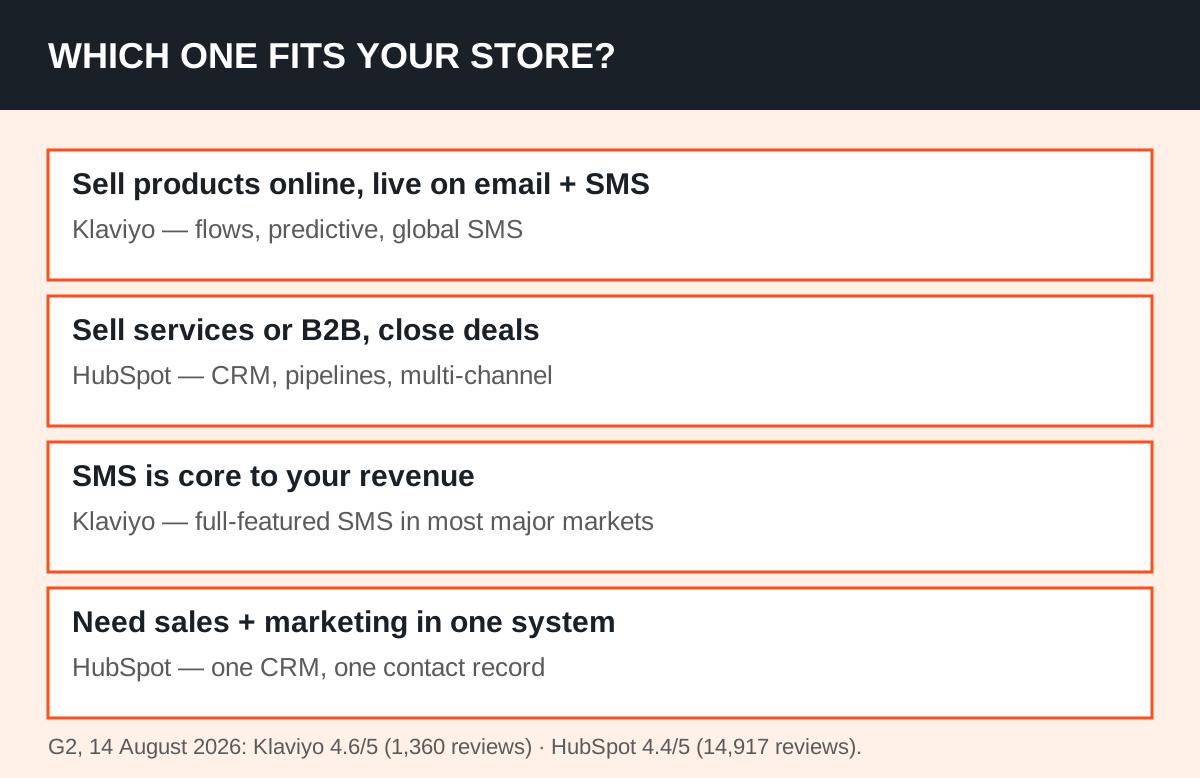
The reviewer scores tell the same story. On G2's side-by-side comparison, Klaviyo scores 4.6 out of 5 from 1,360 reviews and HubSpot Marketing Hub scores 4.4 from 14,917 reviews. Reviewers switch to Klaviyo for cheaper ecommerce email automation; HubSpot's most-cited strength is ease of use.
So the question is not which tool is better. It is which centre matches your business.
What does each one cost at your list size?
Price is where the two platforms diverge fastest, so here is the table first. Klaviyo's figures come from Klaviyo's pricing page, read 11 November 2026. HubSpot's Starter figure is its published per-seat list price; Professional and Enterprise are list prices cross-checked against G2 and independent reads of HubSpot's pricing page in October 2026.
| Contacts | Klaviyo Email | Klaviyo Marketing | HubSpot Starter (1 seat) |
|---|---|---|---|
| 500 | $20 | $25 | $20 |
| 1,000 | $30 | $40 | $20 |
| 2,500 | $60 | $80 | $20 + extra contacts |
| 5,000 | $100 | $130 | $20 + extra contacts |
| 10,000 | $150 | $195 | See Professional below |
Two things to notice. First, the starting prices are identical at $20. Second, Klaviyo's price climbs with your list, while HubSpot Starter stays flat per seat — it charges for contacts separately from seats.
Starter includes 1,000 marketing contacts. Beyond that you buy extra contacts on top, and HubSpot publishes no simple per-block price — so the Starter column is only the seat price, not the full bill at larger lists.
Professional changes the maths completely: $800 a month on annual billing, or $890 month-to-month, with 2,000 contacts, three Core Seats, and a $3,000 one-time onboarding fee. Enterprise is $3,600 a month on annual billing only, with 10,000 contacts, five Core Seats, and a $7,000 onboarding fee.
On Klaviyo's side, Email is email only. Marketing adds social marketing, reviews and the Customer Hub for your full profile count. SMS is no longer a flat bundle: it is a per-message add-on, $0.011 per US text on toll-free numbers or $0.009 on short codes, plus carrier fees.
One warning for readers of older guides: Klaviyo restructured its plans during 2026, and the old Email + SMS bundle figures you may still see no longer match the current page. The current lineup is Free, Email, Marketing and Custom. Our Klaviyo pricing guide covers the ladder in full, including the suppression lever that lowers the bill.
Both platforms have a genuine free tier. Klaviyo free covers 250 active profiles and 500 emails a month, with email support for the first 60 days only.
HubSpot free covers 2,000 sends a month with branding, one automated action, and a free CRM — its FAQ says non-marketing contacts can be stored free up to 15 million contacts.
Email, flows and SMS: where each one wins
On email, Klaviyo has the deeper bench for stores: 370+ templates with product, coupon and countdown blocks, plus dynamic content that pulls your products in. HubSpot ships 50+ templates with CRM personalisation and cart blocks.
The flow builders tell the same story at different depths. Klaviyo's flows cover welcome, abandoned cart, post-purchase, price-drop and low-inventory triggers, with 500+ pre-built templates and an AI flow audit. HubSpot's workflows span marketing, sales and service — broader, less tuned to the store.
Automation limits matter at the cheap end. HubSpot free allows one automated action, Starter up to ten; unlimited actions need Professional. Klaviyo includes flows and A/B testing on every paid plan, but not A/B testing on free.
SMS is the clearest single difference in the whole comparison. Klaviyo's is full-featured and global — the US, Canada, the UK, Australia, New Zealand and most of the EU — with two-way messaging, keywords and surveys. HubSpot's is basic, limited to the US and Canada, and only an add-on on Professional and Enterprise.
If texting drives a real share of your revenue — abandoned-cart texts, flash-sale alerts, back-in-stock messages — that one row decides the comparison. If SMS is a someday idea, ignore this row.
For a wider view before you commit, our best email marketing software for ecommerce stores guide compares Klaviyo with Mailchimp, Omnisend, Brevo and Shopify's own email tool.
The store connection: Shopify, data and the CRM underneath
Both connect to Shopify, WooCommerce, BigCommerce, Magento and Square — the difference is what the connection does with your data.
Klaviyo's Shopify sync turns orders, abandoned checkouts and product views into marketing events, which drive the flows, the segments and the predictive analytics. It is a marketing connection first: the store's behaviour becomes the trigger.
HubSpot's Shopify data writes to contact records instead, and can auto-create deals from orders. That fits a business where the store is one channel among several, and the sale starts a relationship, not a funnel.
Klaviyo lists 350+ apps, concentrated on ecommerce; HubSpot lists 2,000+ across sales, service, operations and marketing. Breadth favours HubSpot; ecommerce depth favours Klaviyo.
The CRM gap is real. HubSpot is a full CRM: pipelines, deals, forecasting, companies, tickets and deduplication. Klaviyo's is built for consumers: unified customer profiles, no sales pipeline, no deal forecasting.
Read that row twice if you sell services alongside products, or if a sales team touches your customers. A store-only business will never miss the pipeline; a hybrid business will feel its absence within months.
Our best CRM software for small businesses guide covers how customer data should flow between store, email tool and CRM. And our Shopify marketing cost guide puts email in the context of a wider store budget.
AI, reporting and the credit meter
Both platforms now sell AI, but they meter it differently. Klaviyo's Composer, its AI marketing agent, went generally available on 13 October 2026. It drafts campaigns, flows and segments from prompts, audits your flows, and runs scheduled tasks.
Predictive analytics — lifetime value, churn risk, next order date — needs at least 500 customers and 180 days of order history.
HubSpot's Breeze is a family of AI agents — prospecting, content, customer and nurture — plus lead scoring and AI revenue forecasting. Breeze runs on HubSpot Credits — and that is where the pricing gets subtle.
Credits cost $0.010 each; paid plans include a monthly allowance: Starter 500, Professional 3,000, Enterprise 5,000. When the allowance runs out, extra work costs extra money — a second meter on top of the subscription.
Reporting splits the same way. Klaviyo reports on email, SMS, flows, deliverability and revenue; custom reports need a paid analytics add-on. HubSpot reports across marketing, sales and revenue attribution, and multi-touch attribution — up to 10,000 logged interactions per contact — sits on Enterprise.
Deliverability is a tie on the features that matter: both guide you through SPF, DKIM, DMARC and BIMI setup, both offer dedicated IPs, and both score 10 out of 10 in the SendPulse comparison.
To compare AI marketing tools beyond these two, our AI tools explorer lists 35 tools with a finder for the job.
The switch cost nobody budgets
The price tables compare month one. The real cost of a wrong pick shows up when you switch — price the exit before you enter.
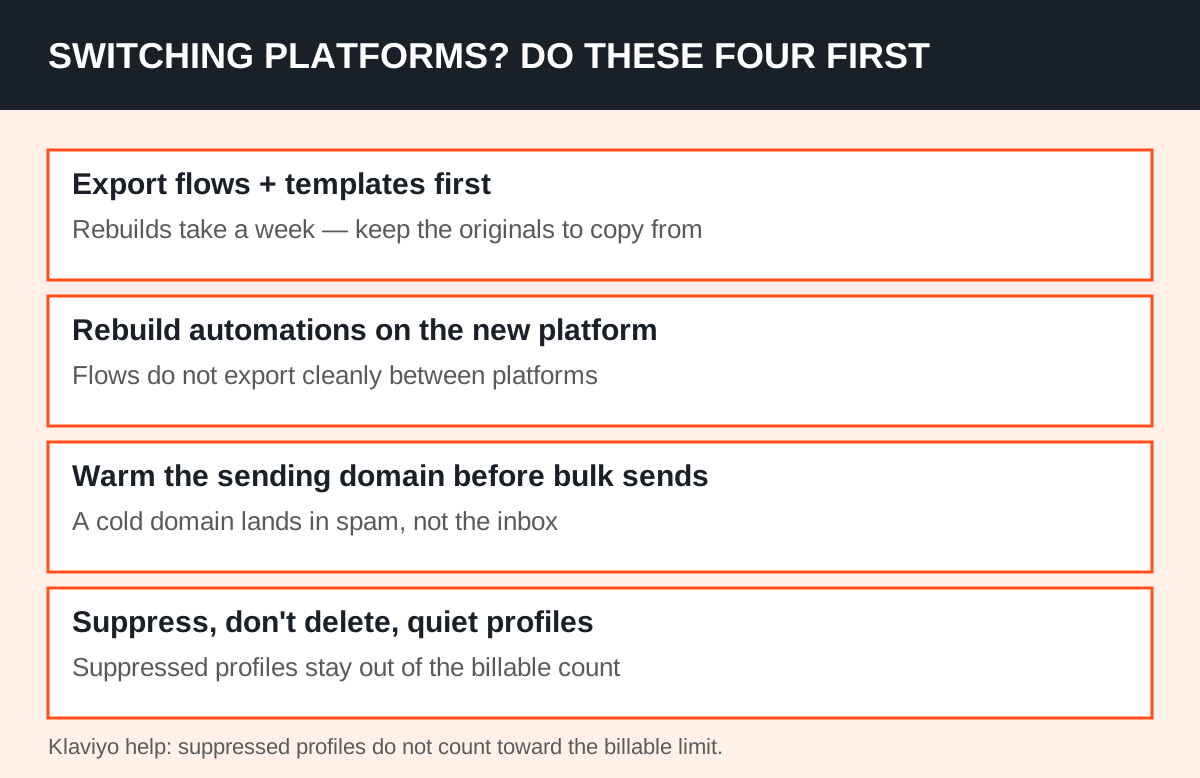
Switching means rebuilding flows, redesigning templates, re-warming your sending domain, and re-testing every automated message — flows do not export cleanly between platforms. A welcome series, an abandoned-cart flow and a post-purchase flow are a week's work to rebuild properly.
Suppress profiles you no longer email rather than deleting them: Klaviyo's help page states suppressed profiles do not count toward the billable limit, and deletion wipes the history that proves someone unsubscribed or marked you as spam.
HubSpot has a contract catch worth reading before you sign: once you select a contact tier, you cannot downgrade until your contract renews — stated on HubSpot's own pricing page. Klaviyo's equivalent is auto-upgrade: pass your tier's profile count and it moves you up at the next billing cycle.
Judge the cost against what your email earns, not the starting price: a welcome series, an abandoned-cart flow and a post-purchase flow should return multiples of the monthly tier.
Our break-even ROAS guide shows the same discipline for paid ads: a cost is only expensive relative to the margin it returns.
Five questions that pick your winner
Forget the feature lists. Answer five questions in order, and the winner picks itself.
What do you sell? Products sold online, with repeat purchases, point to Klaviyo. Services, or products sold through a conversation, point to HubSpot.
Does SMS earn you money? If texts drive a real share of revenue, Klaviyo's global SMS wins outright. If SMS is a someday idea, ignore this row.
Do you need a sales pipeline? If anyone on your team closes deals, HubSpot's CRM decides it. If nobody does, Klaviyo's consumer profiles are enough.
How big will your list be in a year? At 10,000 contacts, Klaviyo Email is $150 a month and HubSpot Professional is $800–$890 before extra contacts — and the gap only widens from there.
Do you want one system or the best tool for email? One system means HubSpot; the best email tool for a store means Klaviyo, with other tools alongside.
| Your store | Pick | Why |
|---|---|---|
| Sell products online, email and SMS drive revenue | Klaviyo | Built for ecommerce: flows, predictive, global SMS |
| Sell services or B2B, a team closes deals | HubSpot | Full CRM, pipelines, marketing across the business |
| List under 1,000, budget is tight | Either free tier | Klaviyo free to 250 profiles; HubSpot free 2,000 sends/mo |
| Growing past 10,000 contacts | Usually Klaviyo | $150 Email vs $800+ Professional before extra contacts |
| Need sales and marketing in one system | HubSpot | One CRM, one contact record, shared reporting |
If your store is the business — products, carts, repeat orders — Klaviyo is the pick; the question is which tier your list size puts you on.
If your store is one channel inside a wider business with a sales team, HubSpot is the pick; the question is whether you can live with Professional's price.
Either way, the platform is the smaller decision. The flows, the list health and the sending habits decide whether email earns its place in the budget. Our email and lifecycle service page shows how flows, campaigns and list health fit together as one program.
Frequently asked questions
Is Klaviyo or HubSpot cheaper for a small store?
At small lists they are close: Klaviyo Email is $20 a month at 500 profiles, and HubSpot Starter is $20 a seat with 1,000 marketing contacts included. The gap opens as you grow — at 10,000 contacts Klaviyo Email is $150 a month while HubSpot Professional lists at $800–$890 a month plus a $3,000 one-time onboarding fee.
Can I use HubSpot for ecommerce email marketing?
Yes. HubSpot connects to Shopify and other stores, and its email builder and workflows cover campaigns and automation. It is strongest when you also need its CRM, pipelines and multi-channel reporting; for store-first email and SMS, Klaviyo's ecommerce features run deeper.
Does Klaviyo have a CRM?
Klaviyo has a B2C CRM built around unified customer profiles, but it has no sales pipeline or deal forecasting. If your team closes deals, you need HubSpot's full CRM or a separate CRM alongside Klaviyo.
Which one is better for SMS marketing?
Klaviyo. Its SMS is full-featured and global, with two-way messaging, keywords and surveys, priced per message. HubSpot's SMS is basic, limited to the US and Canada, and available only as an add-on on Professional and Enterprise plans.